
← All marine life
Bluntnose Sixgill Shark
Species IUCN · Near Threatened (NT)

Bluntnose Sixgill Shark

Hexanchus griseus, (Bonnaterre, 1788)

marine

About Bluntnose Sixgill Shark

The bluntnose sixgill shark (Hexanchus griseus), often simply called the cow shark, is the largest hexanchoid shark, growing to 18 ft (5.5 m) in length. It is found in tropical and temperate waters worldwide. Its diet varies widely depending on the habitat.

The bluntnose sixgill is a species of sixgill shark, of genus Hexanchus, which also consists of two other species: the bigeye sixgill shark (Hexanchus nakamurai) and the Atlantic sixgill shark (Hexanchus vitulus). By analyzing their base pairs of mitochondrial genes COI and ND2, these species can be easily distinguished.

Appearance

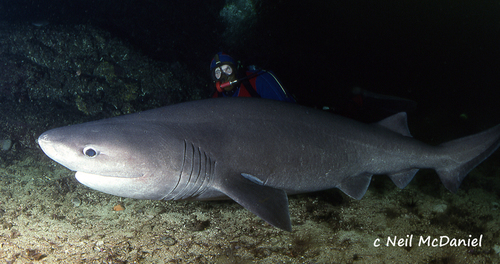
The bluntnose sixgill shark has a large body and long tail. The snout is blunt and wide, and its eyes are small. There are 6 rows of saw-like teeth on its lower jaw and smaller teeth on its upper jaw. Skin color ranges from tan, through brown, to black. It has a light-colored lateral line down the sides and on the fins' edges, and darker colored spots on the sides. They also get stains/spots on their neural arches, and the number of stains increase as they get older. Its pupils are black and its eye color is a fluorescent blue-green. The bluntnose sixgill shark can grow to 5.5 m (18 ft). A work from the 1880s stated that a bluntnose sixgill shark caught off Portugal in 1846 measured 9 m (30 ft). This specimen was originally reported in an 1846 work and said to be only 0.68 m (2.2 ft) long.
Habitat

With a global distribution in tropical and temperate waters, the bluntnose sixgill shark is found in a latitudinal range between 65°N and 48°S in the Atlantic, Indian, and Pacific oceans. It has been seen off the coasts of North and South America from North Carolina to Argentina and Alaska to Chile. In the eastern Atlantic, it has been caught from Iceland to Namibia, in the Indo-Pacific it has been caught from Madagascar north to Japan and east to Hawaii and in the Mediterranean it has been caught in Greece and Malta. Fossilized remains of this species from the Middle Miocene have also been discovered in the Duho Formation of South Korea. It typically swims near the ocean floor or in the water column over the continental shelf in poorly lit waters.

Diet

Sixgill sharks possess variability in their feeding mechanisms that could have contributed to their evolutionary success and global distribution. These sharks are able to protrude their jaws and vary their methods of feeding depending on the situation. They utilize sawing and lateral tearing techniques to manipulate food. Sixgill sharks also lower their pectoral fins right before they strike in order to stop forward progressions, making it easier for them to forage.

Behaviour

Although sluggish in nature, the bluntnose sixgill shark is capable of attaining high speeds for chasing and catching its prey using its powerful tail. Because of its broad range, it has a wide variety of prey, including bony fish (such as dolphinfish, billfish, flounder, and lingcod), hagfish, lampreys, rays, chimaeras, squid, crabs, shrimps, snails, seals, cetaceans, carrion, and other (smaller) sharks (such as spiny dogfish, longnose dogfish, shortnose dogfish, and prickly sharks). The bluntnose sixgill shark is therefore classified as a generalist species, and is less likely to be affected by scarcity in any one of its food sources. A study done in 1986, with 28 sixgills, discovered that the most abundant meal they were able to obtain include cartilaginous and bony fishes, followed by marine mammals and several invertebrates.

Humans & conservation

The bluntnose sixgill shark is listed as Near Threatened by the International Union for Conservation of Nature (IUCN) because, despite its extensive range, its longevity and popularity as a sport fish makes it vulnerable to exploitation and unable to sustain targeted fishing for very long. Although population data is lacking in many areas for this species, certain regional populations have been classified as severely depleted. Although it is usually caught as bycatch, it is also caught for food and sport. In June 2018, the New Zealand Department of Conservation classified the bluntnose sixgill shark as "Not Threatened" with the qualifiers "Data Poor" and "Secure Overseas" under the New Zealand Threat Classification System.

This species is harmless to humans unless provoked.

Part of

Where to see it

No dive sites list Bluntnose Sixgill Shark yet. Explore the map to find sites near you.