
← All marine life
Bluethroat Wrasse
Species IUCN · Least Concern (LC)

Bluethroat Wrasse

Notolabrus tetricus, (Richardson, 1840)

marine

About Bluethroat Wrasse

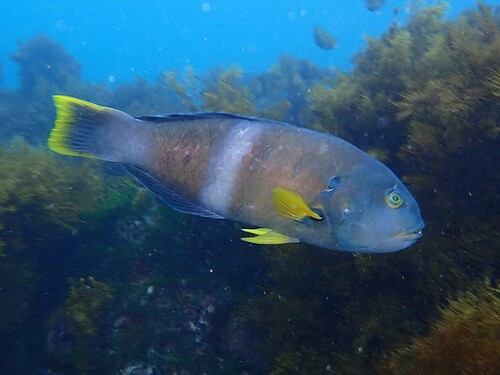
The blue-throated wrasse (Notolabrus tetricus), also known as the bluehead, bluehead parrotfish, bluenose, bluenose parrotfish, bluethroat parrotfish, blue-throat wrasse, kelpie, lilac banded parrotfish, rocky bream, rocky cod, rotfish or winter bream, is a species of marine ray-finned fish from the family Labridae, the wrasses. It is found in the Indian and Pacific Ocean off the south-eastern coasts of Australia.

Appearance

The body of the blue throated wrasse is moderately deep, and its snout is somewhat rounded. The males vary in colour and can have bodies which have greyish, greenish-blue or reddish-orange background colour. The head is pale with a blue chin and throat, the pectoral, pelvic and anal fins are yellow. There is an obvious, thick white vertical bar around the middle part of the body. Females and juveniles are greenish or brownish with a mottled pattern, they frequently show a large vertical patch with smaller white patches on the body next to it. Older females develop paler colouration to the rear of the vertical bar. This species can attain a total length of 50 centimetres (20 in) but the most common size for males is 30 to 45 centimetres (12 to 18 in) while females are normally 20 to 35 centimetres (7.9 to 13.8 in).
Habitat

The blue-headed wrasse is endemic to the waters of south eastern Australia where it is found from Newcastle, New South Wales and Sydney in New South Wales south to Victoria and Tasmania, east to South Australia. They are ones of the dominant species of reef fish off northern Tasmania and southern Australia.

Humans & conservation

Blue-throated wrasse are a quarry species for recreational and commercial fisheries. Live fish have been marketed since the early 1990s and the total catch of this species and of N. fucicola increased from less than 10 tonnes to nearly |60 tonnes in 1995/96. The main market is restaurants in Sydney. It is frequently caught using hook and line but it is also taken by trawlers and by commercial gillnets. Spearfishers also take this species, and it is common bycatch in lobster fisheries. Some states in Australia have set bag limits.

Part of

Where to see it

No dive sites list Bluethroat Wrasse yet. Explore the map to find sites near you.