
← All marine life
Bluestreak Cleaner Wrasse
Species IUCN · Least Concern (LC)

Bluestreak Cleaner Wrasse

Labroides dimidiatus, (Valenciennes, 1839)

marine

About Bluestreak Cleaner Wrasse

The bluestreak cleaner wrasse (Labroides dimidiatus) is one of several species of cleaner wrasses found on coral reefs from Eastern Africa and the Red Sea to French Polynesia. Like other cleaner wrasses, it eats parasites and dead tissue off larger fishes' skin in a mutualistic relationship that provides food and protection for the wrasse and considerable health benefits for the other fishes. It is also notable for having potentially passed the mirror test.

Appearance

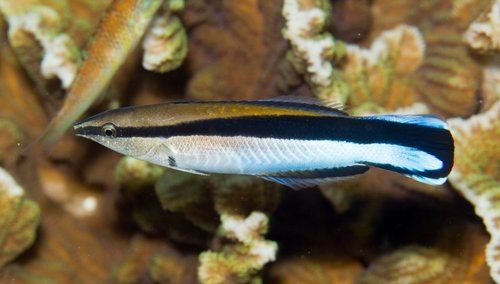
This is a young wrasse, averaging 10 cm (3.9 in) long, at most 14 cm (5.5 in). It can be recognized due to a wide, longitudinal, black stripe running along the side and eye; the back and the stomach are white (sometimes slightly yellowish). This white part changes to a bright blue on the front of the animal, while the black band widens at the tail. The young are black with an electric-blue line.

Habitat

The bluestreak cleaner wrasse is found on coral reefs in the tropics from the Red Sea and Indian Ocean to the western Pacific (including Papua New Guinea, Japan, Fiji, and French Polynesia). It was first recorded from the Kermadec Islands Marine Reserve north of New Zealand in 2015, after researchers examined hundreds of hours of unused documentary film footage.

Reproduction

Cleaner wrasse males defend specific living territories from other males in which they are able to have control over the females in those territories. When the dominant male no longer exists in that territory, one of the larger females is able to change sexes to take control over that territory.

Part of

Where to see it

No dive sites list Bluestreak Cleaner Wrasse yet. Explore the map to find sites near you.