
← All marine life
Bluespotted Trevally
Species IUCN · Least Concern (LC)

Bluespotted Trevally

Caranx bucculentus, Alleyne & MacLeay, 1877

marinebrackish

About Bluespotted Trevally

The bluespotted trevally (Caranx bucculentus), also known as the wide-mouthed trevally, is a species of moderately large marine fish in the jack family Carangidae. The bluespotted trevally is distributed through the tropical east Indian and west Pacific Oceans, ranging from Taiwan in the north to Australia in the south. It is an inshore species, found in sandy, muddy and seagrass environments, often in large bays. The bluespotted trevally is distinguished by dark blue spots on its upper body, as well as a number of more detailed anatomical features. It is a benthopelagic predator, taking a variety of crustaceans including crabs and prawns as a juvenile, before shifting to a more fish-dominated diet as an adult. It is one of the most common predators in the Gulf of Carpentaria of northern Australia, and is considered the most important predator of commercially important prawn species. Sexual maturity is reached at 110 mm in length and one year of age, with spawning occurring year round with a peak in spring. Growth is estimated to be 82.2 mm per year for both sexes, reaching a maximum known length of 66 cm. Bluespotted trevally are commonly taken as bycatch in prawn fisheries, however are of little commercial value and often discarded. They are occasionally taken by anglers on lures and baits, but are considered mediocre table fare.

Appearance

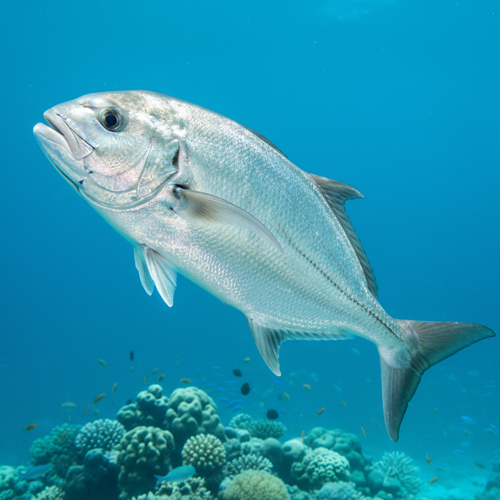
The bluespotted trevally is a moderately large fish, growing to a known maximum length of 66 cm. It has a body shape characteristic of many of the larger species of Caranx, possessing a strongly compressed, oblong form with the dorsal profile, particularly anteriorly, much more convex than the ventral profile. The dorsal fin is in two distinct sections, the first consisting of eight spines while the second has one spine and 18 or 19 soft rays. The anal fin consists of two detached spines anteriorly followed by one spine and 15 to 17 soft rays, while the pelvic fin has 1 spine followed by 18 soft rays. The species lateral line is very strongly curved over a short length, becoming straight before the origin of the second dorsal fin, with this straight section over 2.5 times the length of the curved section.
Habitat

The bluespotted trevally inhabits the tropical waters of the East Indian-West Pacific Ocean, and is restricted to a smaller range than most of its relatives. The species range extends from the waters of the South China Sea around Taiwan and Borneo south through eastern Indonesia and the Arafura Sea around Papua New Guinea. The species is commonly found off northern Australia, especially the Gulf of Carpentaria, but is occasionally seen as far south as Gladstone, Queensland.

Humans & conservation

Despite the large populations of bluespotted trevally, particularly in northern Australia, no major fishery is based around the species. They are taken by trawls and hook-and-line methods throughout their range, but form a considerable proportion of some prawn-trawler bycatches. Despite this, they are generally considered of no worth due to their mediocre reputation as table fish, as well as the possibility of ciguatera poisoning from larger specimens.

Bluespotted trevally are occasionally caught by recreational fishermen on various baits and lures, and are considered to a good sport fish, but tend to be overshadowed by giant trevally and bluefin trevally in reputation.

Part of

Where to see it

No dive sites list Bluespotted Trevally yet. Explore the map to find sites near you.