
← All marine life
Bluespine Unicornfish
Species IUCN · Least Concern (LC)

Bluespine Unicornfish

Naso unicornis, (Forsskål, 1775)

marine

About Bluespine Unicornfish

The bluespine unicornfish (Naso unicornis), also known as the short-nose unicornfish, is a species of marine ray-finned fish belonging to the family Acanthuridae, the surgeonfishes, unicornfishes and tangs. This species is found in the Indo-Pacific. It is occasionally found in the aquarium trade. It grows to a size of 70 cm in length. It is called kala ('thorn') in Hawaii, dawa in New Caledonia, and ta or tā in Fiji. However the name kala refers to all three species of horned unicornfish found around Hawaii.

Appearance

The bluespine unicornfish has a blueish-gray body with two blue spines on each side at the base of the tail and a short rostrum or bony horn on the forehead. In small fish the horn is missing. The species is sexually dimorphic, with males having much larger tail spines than females. Males on average also have slightly longer horns and slightly longer tail streamers than females.

These fish have a leather-like skin instead of scales. The bluespine unicornfish can grow up to 70 cm (28 in) with the largest one caught to be 5.8 kg (13 lb).
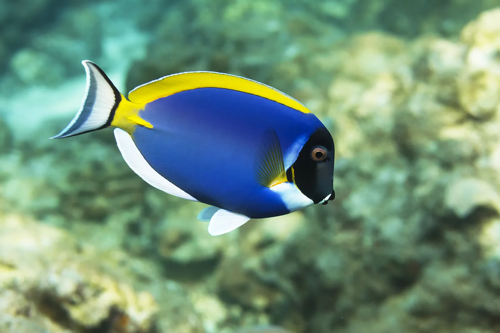
Habitat

The bluespine unicornfish is very common in the tropical Indo-Pacific region, usually occurring at temperatures between 25 and 29 °C (77 and 84 °F).

Diet

Bluespine unicornfish are herbivores and feed on brown and red algae with coarse or leafy blades (such as Sargassum). Because it is one of a small number of species that consumes fleshy macroalgae (seaweed), it is of great importance to coral reef ecosystems.

Humans & conservation

Bluespine unicornfish are eaten in abundance due to how common they are. They are caught using nets, hook and line techniques, and by nighttime spearfishing. They have a strong flavor and odor due to their diet. When skinned, the meat is white with a slight pink-red taint and a firm or moist texture. Bluespine unicornfish are usually eaten raw, boiled, grilled, baked or sauteed.

The kala, the Hawaiian name for Naso unicornis and two other Naso species, was an important food source in pre-colonial Hawaii. The tough skin of kala was sometimes stretched over a half coconut shell to make a small knee drum. The Hawaiians also used kala in ceremonies between members of a tribe or between tribes. Today kala is still a common food source to the people of Hawaii and other Pacific Islands.

Part of

Where to see it

No dive sites list Bluespine Unicornfish yet. Explore the map to find sites near you.