
← All marine life
Bluehead Wrasse
Species IUCN · Least Concern (LC)

Bluehead Wrasse

Thalassoma bifasciatum, (Bloch, 1791)

marine

About Bluehead Wrasse

Thalassoma bifasciatum, the bluehead, bluehead wrasse or blue-headed wrasse, is a species of marine ray-finned fish, a wrasse from the family Labridae. It is native to the coral reefs of the tropical waters of the western Atlantic Ocean. Individuals are small (less than 110 mm standard length) and rarely live longer than two years. They form large schools over the reef and are important cleaner fish in the reefs they inhabit.

Appearance

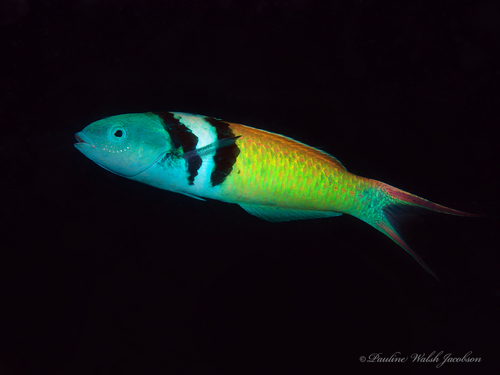
Young/small females and males have yellow upper bodies and white lower bodies, often with green or black lateral stripes and occasionally dark vertical bars. This coloration is known as the initial phase. They can rapidly alter the presence or intensity of their yellow color, stripes, and bars, and these color changes appear to correspond to behavioral changes. Large females and some males can permanently change coloration and/or sex and enter the terminal phase coloration, which has a blue head, black and white bars behind the head, and a green body. This color phase gives the species its name. Terminal phase males are larger (70 to 80 mm) than the initial phase males (60 mm).

Habitat

Thalassoma bifasciatum is found in coral reefs of the Atlantic Ocean. Its main range includes the Caribbean Sea and the southeast area of the Gulf of Mexico.

In Punta Cana, Dominican Republic, the bluehead wrasse is a common sight for scuba divers and snorkelers exploring local reefs.

Diet

Though Thalassoma bifasciatum is a common cleaner fish in the coral reefs they inhabit, they avoid cleaning piscivores such as the spotted moray, the graysby, and the red hind. Such species will view them as prey, but will not view gobies, another kind of cleaner fish, as prey. Other predators include the greater soapfish, roughtail stingray, and the trumpetfish.

A significant parasite of T. bifasciatum is the intracellular myxozoan Kudoa ovivora, which can be found in the ovaries of females. Infected eggs are sterile and are also larger than uninfected eggs, and contain more organic and inorganic material. This implies the parasite causes a shift in resources from the mother to the eggs and decreases the fitness of the mother. Infected bluehead wrasses have been found to change sex earlier than uninfected females, possibly in response to the parasite.

Behaviour

Thalassoma bifasciatum forages for zooplankton, mollusks, small crustaceans (such as shrimp and krill), worms, other motile invertebrates, and the eggs of smaller fish, as well as ectoparasites on other fish. Initial phase males eat primarily zooplankton from currents, and females and initial phase males have certain hunting times during the day.

Reproduction

Large terminal phase males will defend breeding sites to which females migrate on a daily basis. A study was done to estimate the relative roles of each sex in choosing the location of such sites. All terminal phase males or all females were replaced in local isolated populations, and the resulting site use was monitored. After males were replaced, the mating system was not affected. On the other hand, after the females were replaced, half of the old sites were lost and the same number of new sites came into use, and continued to be occupied for over a year after these manipulations. This occurred although large males originally continued to defend and display at the original sites. Therefore, this shows the importance of female choice in the feeding system of the blue-headed wrasse, and that males will respond to the females' site preferences.

Humans & conservation

Thalassoma bifasciatum is widespread in the northwestern Atlantic region and is one of the most abundant species in coral reefs near Puerto Rico, the Virgin Islands, and the Netherlands Antilles. It is listed under Least Concern. However, this species shows high site fidelity, so coral reef destruction could cause local endangerment. Due to its bright coloration, it is sometimes collected for the aquarium trade, but this is not a threat to the species.

Part of

Where to see it

No dive sites list Bluehead Wrasse yet. Explore the map to find sites near you.