
← All marine life
Bluefish
Species IUCN · Vulnerable (VU)

Bluefish

Pomatomus saltatrix, (Linnaeus, 1766)

marinebrackish

About Bluefish

The bluefish (Pomatomus saltatrix) is the only extant species of the family Pomatomidae. It is a marine pelagic fish found around the world in temperate and subtropical waters, except for the northern Pacific Ocean. Bluefish are known as tailor in Australia and New Zealand, elf and shad in South Africa. It is a popular gamefish and food fish.

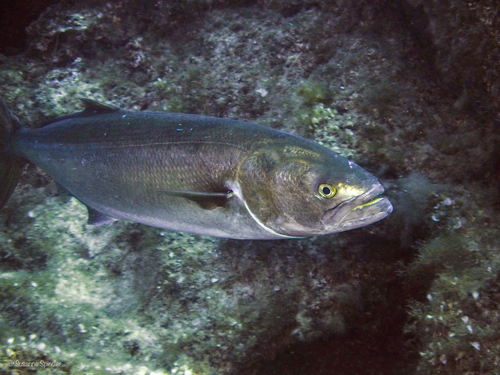
The bluefish is a moderately proportioned fish, with a broad, forked tail. The spiny first dorsal fin is normally folded back in a groove, as are its pectoral fins. Coloration is a grayish blue-green dorsally, fading to white on the lower sides and belly. Its single row of teeth in each jaw is uniform in size, knife-edged, and sharp. Bluefish commonly range in size from "snappers" of 7 in (18 cm) to much larger, sometimes weighing as much as 30 lb (14 kg), though fish heavier than 20 lb (9 kg) are exceptional.

Habitat

Bluefish are widely distributed around the world in tropical and subtropical waters. They are found in pelagic waters on much of the continental shelves along eastern America (though not between south Florida and northern South America), Africa, the Mediterranean and Black Seas (and during migration in between), Southeast Asia, and Australia. They are found in a variety of coastal habitats: above the continental shelf, in energetic waters near surf beaches, or by rock headlands. They also enter estuaries and inhabit brackish waters. Periodically, they leave the coasts and migrate in schools through open waters.

Diet

Adult bluefish are strong and aggressive, and live in loose groups. They are fast swimmers that prey on schools of forage fish, and continue attacking them in feeding frenzies even after they appear to have eaten their fill. Depending on area and season, they favor menhaden and other sardine-like fish (Clupeidae), jacks (Scombridae), weakfish (Sciaenidae), grunts (Haemulidae), striped anchovies (Engraulidae), shrimp, and squid. They are cannibalistic and can destroy their own young. Bluefish sometimes chase bait through the surf zone, attacking schools in very shallow water, churning the water like a washing machine. This behavior is sometimes referred to as a "bluefish blitz".

Behaviour

Adult bluefish are typically 30–60 cm (12–24 in) long, with a maximum reported size of 130 cm (51 in) and 14 kg (31 lb). They reproduce during spring and summer, and can live up to 9 years. Bluefish fry eat zooplankton, and are largely at the mercy of currents. Spent bluefish have been found off east-central Florida, migrating north. As with most marine fish, their spawning habits are not well known. In the western side of the North Atlantic, at least two populations occur, separated by Cape Hatteras in North Carolina. The Gulf Stream can carry fry spawned to the south of Cape Hatteras to the north, and eddies can spin off, carrying them into populations found off the coast of the mid-Atlantic, and the New England states.

Humans & conservation

In Australia, bluefish, called "tailor", are caught on the east coast from Fraser Island in Queensland around the Australian coastline to Point Quobba in Western Australia, including Tasmania. Lower numbers are generally found around southern Australia. Tailor are pelagic, forming schools near the surface, and move inshore to feed in bays, estuaries, and surf zones at depths up to 15 m. The juveniles inhabit large bays and estuaries, while adults prefer the rocky headlands and beaches. Globally, the species occurs in tropical and temperate waters of the Atlantic, Pacific, and Indian Oceans, but is absent from the Eastern and Northwestern Pacific.

Where to see it

No dive sites list Bluefish yet. Explore the map to find sites near you.