
← All marine life
Bluebanded Goby
Species IUCN · Least Concern (LC)

Bluebanded Goby

Lythrypnus dalli, (Gilbert, 1890)

marine

About Bluebanded Goby

The blue-banded goby (Lythrypnus dalli) is a member of the Gobiidae family, found abundantly in rocky reefs of the Pacific Ocean, ranging from Morro Bay, California to the Galápagos Islands, Ecuador.

Appearance

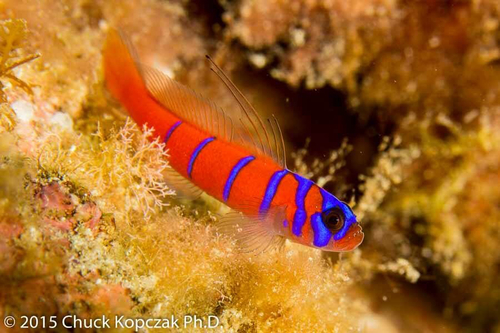
Blue-banded goby reach a maximum adult size of around 64mm (roughly 2.5 inches), with standard ranges varying from 18-45mm (0.7-1.8 in). They are brightly colored coral-red, with 5-9 blue bands present towards the front of their bodies. They have two dorsal fins, with a tall, spiny fin placed towards the head, and a longer soft-rayed fin extending down the back. Like the round goby, they have a wide pelvic fin on either side of their body, which they use as a suction cup to cling to rocks in fast-moving currents.

As a defense mechanism, lythrypnus dalli secrete a mild toxin, making them irritating to eat. Other species of goby mimic their coloration and pattern to utilize this protection.

Habitat

Lythrypnus dalli is commonly found in rocky reef environments, preferring hard substrates and sloped surfaces for their dwelling. Often found in open rocky areas and caves close to the ocean floor, they live at depths of around 0-76m (0-250 feet) below sea level. When approached or threatened, they often retreat into small crevices, sometimes taking refuge within the spines of Sea urchin.

Diet

Being so small, the blue-banded goby feeds mainly on small creatures like zooplankton and miniature crustaceans. In some cases, they serve as cleaner fish, eating ectoparasites from other organisms. Their feeding behavior consists of swimming a short distance away from their reef and grabbing items to quickly take back into the reef, which includes amphipods and small crabs.

Reproduction

The blue-banded goby exhibits a controlled reproductive system using bidirectional sex change. They can function as either a female or a male, depending on the social environment. Blue-banded gobies typically form harems consisting of one male and multiple females, where elimination of males due to predation or absence of males results in the largest female goby switching sex to assume the male role. Courtship behavior involves a male rushing at a female and nipping their genital area and locking jaws. Eggs are found along the walls of the brood chamber until a shell is found for the eggs to be deposited into. Males assume a strict task of guarding nests, using fanning motions of their pectoral fins to help develop eggs while warding off intruders. Breeding season starts around February and ends by about September.

Where to see it

No dive sites list Bluebanded Goby yet. Explore the map to find sites near you.