
← All marine life
Blue Tang
Species IUCN · Least Concern (LC)

Blue Tang

Acanthurus coeruleus, Bloch & Schneider, 1801

marine

About Blue Tang

Acanthurus coeruleus is a species of marine ray-finned fish belonging to the family Acanthuridae, the surgeonfishes, unicornfishes and tangs, found in the Atlantic Ocean. It can grow up to 39 centimetres (15 in) long. Common names include Atlantic blue tang, blue barber, blue doctor, blue doctorfish, blue tang, blue tang surgeonfish, yellow barber, and yellow doctorfish.

Appearance

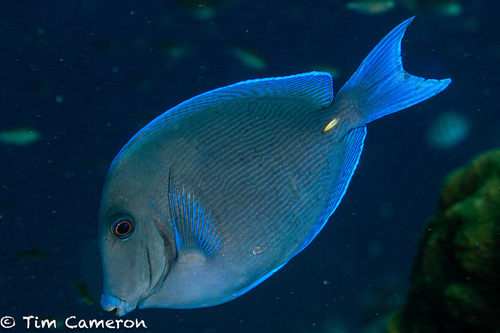
Although the body of the reef fish can vary in shade from light to dark blue, the dorsal, anal and caudal fins are golden blue. As juveniles, the edges on their dorsal and anal fins and the rings around their eyes are purple-blue, blue or blue-green. Their colors change during growth from a yellow juvenile, yellow tailed blue subadult and the blue adult phase.

Acanthurus coeruleus exhibits biofluorescence, that is, when illuminated by blue or ultraviolet light, it re-emits it as green, and appears differently than under white light illumination (see image to the right). Biofluorescence may assist in intraspecific communication and camouflage.

Habitat

Acanthurus coeruleus is present in the western Atlantic Ocean from New York to Florida, Mexico and Brazil, and Ascension Island in the Mid-Atlantic. Also found in the Mediterranean Sea since 2011.

Diet

Food distribution, density, and accessibility can determine population density and territory size in blue tangs. Territories with low biogenic structure are larger than those of higher biogenic structure. Since the algal food resources are less dense in low-biogenic structured areas, these territories would have to be larger in order to include the necessary amount of food. This is in accordance with the Ideal free distribution model. This model states that competitors should adjust their distribution in accordance with habitat quality such that each individual will gain the same amount of resources.

Behaviour

Atlantic blue tangs inhabit coral reefs as well as nearby grassy and rocky coastal areas where algae are abundant. They are herbivorous, feeding primarily on filamentous algae, detritus and plankton. They eat the algae from the reefs in which they reside, as well as off the bodies of surrounding fish. By eating the algae off of other fish, the blue tang serve as cleaners for them. With the decline in the Diadema antillarum (sea urchin) population, the blue tang population increased since the algal resources that the two animals usually competed for were more abundant.

Humans & conservation

While not under human threat, the Atlantic blue tang is caught for commercial fishing, but maintains little importance to Caribbean industry. It is also used, though rarely, as bait. It is also common in the aquarium trade.

The fish is of low commercial value, giving off a pungent stench. Ciguatera poisoning may occur if the flesh is consumed. The adult fish's caudal spine is sharp, and is only out when the fish experiences excitement of some form. These fins can cut very deep into human skin and have been known to result in infections, mainly characterized by swelling and discoloration. Pain from such infections can last for long periods of time, sometimes for hours. Some species of the genus Acanthurus are even thought to possess poison glands on their caudal spines.

Part of

Where to see it

No dive sites list Blue Tang yet. Explore the map to find sites near you.