
← All marine life
Blue Shark
Species IUCN · Near Threatened (NT)

Blue Shark

Prionace glauca, (Linnaeus, 1758)

marinebrackish

About Blue Shark

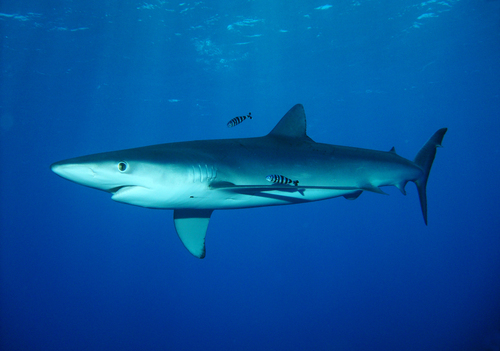
The blue shark (Prionace glauca), also known as the great blue shark, is a species of requiem shark in the family Carcharhinidae which inhabits deep waters in the world's temperate and tropical oceans. It is the only living species of genus Prionace. An extinct species, P. clarki, is known from teeth from California of the Late Pliocene. Averaging around 3.1 m (10 ft) and preferring cooler waters, the blue shark migrates long distances, such as from New England to South America. It is listed as Near Threatened by the IUCN.

Although generally lethargic, they can move very quickly. Blue sharks are viviparous and are noted for large litters of 25 to over 100 pups. They feed primarily on small forage fish and squid, although they can take larger prey. Some of the blue shark's predators include the killer whale and larger sharks like the tiger shark and the great white shark. Their maximum lifespan is still unknown, but it is believed that they can live up to 20 years. They are one of the most abundant pelagic sharks, with large numbers being caught by fisheries as bycatch on longlines and nets.

The earliest fossil teeth of this species are known from the Miocene of Sri Lanka. Other fossil teeth of this species are known from the Miocene and Pliocene of Chile, Italy, and possibly Belgium.

Appearance

Blue sharks are light-bodied with long pectoral fins. Like many other sharks, blue sharks are countershaded: the top of the body is deep blue, lighter on the sides, and the underside is white. The male blue shark commonly grows to 1.82 to 2.82 m (6.0 to 9.3 ft) at maturity, whereas the larger females commonly grow to 2.2 to 3.3 m (7.2 to 10.8 ft) at maturity. Large specimens can grow to 3.8 m (12 ft) long. Occasionally, an outsized blue shark is reported, with one widely printed claim of a length of 6.1 m (20 ft), but no shark even approaching this size has been scientifically documented. The blue shark is fairly elongated and slender in build and typically weighs from 27 to 55 kg (60 to 121 lb) in males and from 93 to 182 kg (205 to 401 lb) in large females. Occasionally, a female in excess of 3 metres (10 ft) will weigh over 204 kg (450 lb).
Habitat

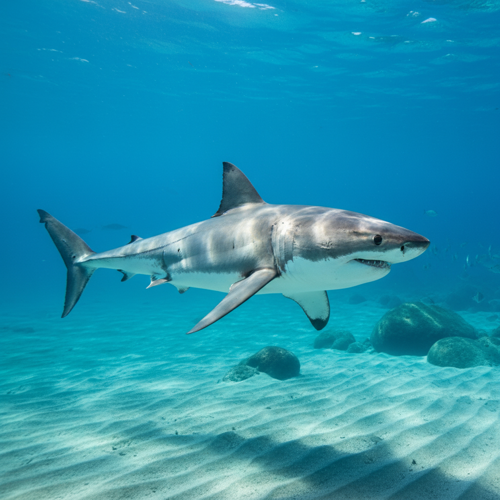
The blue shark is an oceanic and epipelagic shark found worldwide in deep temperate and tropical waters from the surface to about 350 m (1,150 ft). In temperate seas it may approach shore, where it can be observed by divers; while in tropical waters, it inhabits greater depths. It lives as far north as Norway and as far south as Chile. Blue sharks are found off the coasts of every continent, except Antarctica. Its greatest Pacific concentrations occur between 20° and 50° North, but with strong seasonal fluctuations. In the tropics, it spreads evenly between 20° N and 20° S. It prefers water temperatures between 12 and 20 °C (54–68 °F), but can be seen in water ranging from 3.9 to 31 °C (39.0–87.8 °F). Records from the Atlantic show a regular clockwise migration within the prevailing currents.

Diet

Squid are the most important prey for blue sharks, but their diet includes other invertebrates, such as cuttlefish, blanket octopuses, and pelagic octopuses, as well as lobster, shrimp, crab, a large number of bony fishes (such as long-snouted lancetfish, snake mackerel and oilfish), small sharks, mammalian carrion and occasional sea birds (such as great shearwaters). Whale and porpoise blubber and meat have been retrieved from the stomachs of captured specimens and they are known to take cod from trawl nets. Sharks have been observed and documented working together as a "pack" to herd prey into a concentrated group from which they can easily feed. Blue sharks may eat tuna, which have been observed taking advantage of the herding behaviour to opportunistically feed on escaping prey.

Behaviour

Male blue sharks primarily court non-pregnant mature females since mating marks on females are common, appearing as several tiny incisions arranged in a semicircle on their Dorsal fins. These marks are the result of non-feeding bites during courtship and mating. Female blue sharks have evolved skin three times thicker than that of males to withstand the rigors of mating.

Female blue sharks are classified as immature, subadult, or mature based on the size and development of their ovary, oviducal gland, and uterus.

Mature females have enlarged uterine walls, a fully differentiated oviducal gland, visible and enlarged Ovarian follicles and a right ovary separated and developed from the epigonal organ.

Immature females have an undifferentiated oviducal gland and uterus, a small right ovary lodged within the epigonal organ, and no visible follicles.

Reproduction

Maturity is assessed by observing sexual products and the developmental stage of reproductive organs.

Five reproductive variables are examined for their relationship to body growth: presence or absence of semen in the ductus deferens ampullae, length and wet weight of the testicle, Size and rigidity of the claspers. To assess maturity, the clasper's inner length and degree of calcification are recorded:

Mature males have fully calcified claspers that extend beyond the inner margin of their pelvic fins.

Immature males have claspers that are either shorter or longer than the inner border but not fully calcified.

Humans & conservation

Blue shark meat is edible, but not widely sought after; it is consumed fresh, dried, smoked and salted and diverted for fishmeal. There is a report of high concentration of heavy metals (mercury and lead) in the edible flesh. The skin is used for leather, the fins for shark-fin soup and the liver for oil. Blue sharks are occasionally sought as game fish for their beauty and speed.

Blue sharks rarely bite humans. From 1580 up until 2013, the blue shark was implicated in only 13 biting incidents, four of which ended fatally.

Part of

Where to see it

No dive sites list Blue Shark yet. Explore the map to find sites near you.