
← All marine life
Blue Mussel
Species

Blue Mussel

Mytilus edulis, Linnaeus, 1758

marine

About Blue Mussel

The blue mussel (Mytilus edulis), also known as the common mussel, is a medium-sized edible marine bivalve mollusc in the family Mytilidae, the only extant family in the order Mytilida, known as "true mussels". Blue mussels are subject to commercial use and intensive aquaculture. A species with a large range, the blue mussel leaves empty shells that are commonly found on beaches around the world.

Appearance

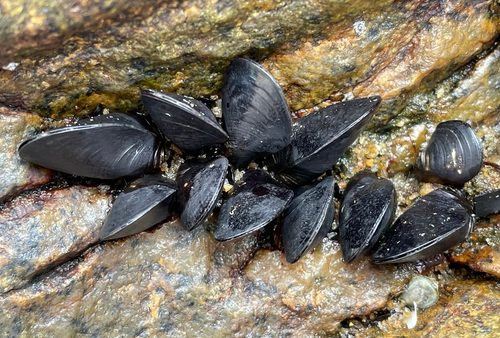
The shape of the shell is triangular and elongated with rounded edges. The shell is smooth with a sculpturing of fine concentric growth lines but no radiating ribs. The shells of this species are purple, blue or sometimes brown in color, occasionally with radial stripes. The outer surface of the shell is covered by the periostracum which as eroded, exposes the colored prismatic calcitic layer. Blue mussels are semi-sessile, having the ability to detach and reattach to a surface allowing the mollusk to reposition itself relative to the water position.
Habitat

Systematically blue mussel consists of a group of (at least) three closely related taxa of mussels, known as the Mytilus edulis complex. Collectively they occupy both coasts of the North Atlantic (including the Mediterranean) and of the North Pacific in temperate to polar waters, as well as coasts of similar nature in the Southern Hemisphere. The distribution of the component taxa has been recently modified as a result of human activity. The taxa can hybridise with each other, if present at the same locality.

Mytilus edulis sensu stricto: Native to the North Atlantic.

Mytilus galloprovincialis, the Mediterranean mussel: Native in the Mediterranean, the Black Sea and Western Europe. Introduced in the temperate North Pacific, South Africa and elsewhere in the Southern Hemisphere.

Diet

Predation of blue mussels is greatest during the three weeks it spends as a planktonic larva. During this stage it is susceptible to jellyfish and fish larvae through adults. Once it metamorphoses the mussel is still restricted by predation, with smaller mussels with thinner, weaker shells most affected. Once the shells becomes stronger, blue mussels are preyed upon by sea stars such as Asterias vulgaris as well as by several species of sea gulls. The capability of shell thickening by mussels has become a very effective defense mechanism. In the presence of predators a mussel is able to increase shell thickness 5 to 10 percent, which in turn makes opening the shell take 50 percent more time. Small mussels are also eaten by the dog whelk, Nucella lapillus. The blue mussel is host to a wide range of parasites, but these parasites usually do not cause much damage.

Reproduction

Mussels have separate sexes. Once the sperm and eggs are fully developed they are released into the water column for fertilization. Although there are about 10,000 sperm per egg, large proportions of eggs deposited by blue mussels are never fertilized. As few as 1% of larvae that do mature ever reach adulthood. The majority are eaten by predators before completing metamorphosis.

Part of

Where to see it

No dive sites list Blue Mussel yet. Explore the map to find sites near you.