
← All marine life
Blue Marlin
Species IUCN · Vulnerable (VU)

Blue Marlin

Makaira nigricans, Lacepède, 1802

marine

About Blue Marlin

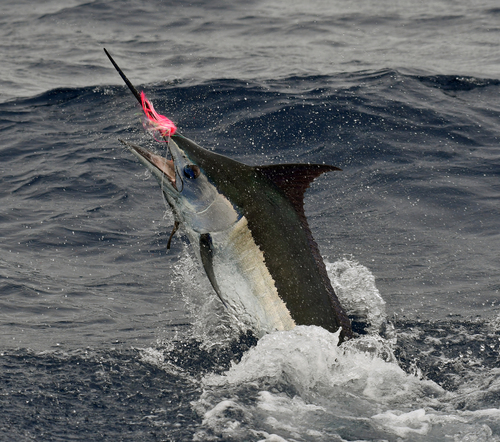
The Atlantic blue marlin (Makaira nigricans) is a species of marlin endemic to the Atlantic Ocean. It is closely related to, and usually considered conspecific with, the Indo-Pacific blue marlin, then simply called blue marlin. Some authorities consider both species distinct. Blue marlin are distributed throughout the tropical and subtropical waters of the Atlantic Ocean. It is a bluewater fish that spends the majority of its life in the open sea far from land.

The blue marlin preys on a wide variety of marine organisms, mostly near the surface, often using its bill to stun or injure its prey then returning to eat the injured or stunned fish. Females can grow up to four times the weight of males. The maximum published weight is 818 kg (1,803 lb) and length 5 m (16.4 ft). Greater lengths have been claimed unofficially. Estimates of the maximum swimming speed of the blue marlin commonly go as high as 72 km/h, though the casual swimming speed at which it moves most of the time is under 4.5 km/h.

Appearance

The biggest females are more than four times as heavy as the biggest males, which rarely exceed 160 kg (350 lb) in weight. The longest females can reach a length of 5 m (16 ft) with the bill, from eye to tip, constituting about 20% of the total body length.

Body mass in the largest female specimens has been reported from 540 to 820 kg (1,190 to 1,810 lb), depending on the source (few large specimens are scientifically verified). The largest blue marlin caught by IGFA angling rules is from Vitoria, Brazil, which weighed 1,402 lb (636 kg).; fishermen often refer to individual marlins that reach or exceed 1,000 pounds as "granders".

Both sexes have 24 vertebrae, of which 11 are precaudal and 13 are caudal.
Habitat

Blue marlin are found year-round in tropical oceanic waters of the Atlantic. The range expands into temperate waters of the Northern and Southern Hemispheres during the warmer months and contracts towards the Equator during colder months. Warm currents, such as the Gulf Stream, in the western Atlantic have a major influence on their seasonal distribution.

Being the most tropic of all the billfishes, they spend a lot of time in the water column shifting from the top to a depth of 100 meters. They spend most nights near the surface and dive to deeper depths during the day. Limited from going any lower by the water temperature and oxygen levels.

Diet

Once blue marlin reach maturity, they have few predators, with the most important being killer whales and large pelagic sharks, such as the shortfin mako and great white shark.

Blue marlin have many parasites, including from these groups: Digenea (flukes), Didymozoidea (tissue flukes), Monogenea (gillworms), Cestoda (tapeworms), Nematoda (roundworms), Acanthocephala (spiny-headed worms), copepods, barnacles, and cookiecutter sharks.

Humans & conservation

Sport fishermen first encountered blue marlin in the Bahamas in the 1920s and early 1930s, when pioneering big-game fishermen such as Van Campen Heilner and S. Kip Farrington began exploring the waters offshore of Bimini and Cat Cay. Since then, blue marlin have been renowned as one of the world's greatest game fishes. The sportfishing pursuit of marlin and other billfish has developed into a multimillion dollar industry that includes hundreds of companies and thousands of jobs for boat operators, boat builders, marinas, dealerships, and fishing tackle manufacturers and dealers.

Part of

Where to see it

No dive sites list Blue Marlin yet. Explore the map to find sites near you.