
← All marine life
Blue Cod
Species IUCN · Least Concern (LC)

Blue Cod

Parapercis colias, (Forster, 1801)

marine

About Blue Cod

The New Zealand blue cod (Parapercis colias) is a temperate marine ray-finned fish of the family Pinguipedidae. It is also known as Boston blue cod, New Zealand cod, and sand perch, and by its Māori names, rāwaru, pākirikiri, and patutuki.

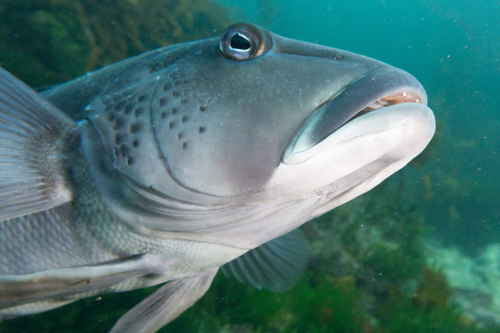
It is exclusively found in New Zealand, in shallow waters around rocky coasts to a depth of 150 m (490 ft), though it is far more common south of Cook Strait. It is bluish green to blue-black above with white toward the belly. Large examples are usually greenish blue in colour, while smaller ones are blotched in varying shades of brown. An adult may grow to 60 cm (24 in) in length and weigh from 1.0 to 3.0 kg (2.2 to 6.6 lb). It feeds mainly on small fish and crabs. Blue cod is territorial. Spawning takes place in southern spring. Blue cod can also change sex from female to male.

It is an important recreational species in the South Island and is commercially harvested. Blue cod populations are managed under New Zealand's fisheries quota management system, although they are becoming scarce in some small areas due to fishing pressure. Annual catch range is between 2,000 and 2,500 tonnes.

Appearance

Parapercis colias are protogynous hermaphrodites, which means they have both female and male reproductive organs at the beginning and some females change sex to males later in their life. P. colias is a marine bottom dwelling fish that is found in coastal New Zealand waters. Their colouring varies by age and sex. Juveniles start off being generally pale in colour and have two long dark stripes along the sides which will turn brown and barely distinguishable when they become middle-sized fish. As they mature with a body length over 25 cm, both sexes would have a blueish-grey dorsal with a white underside. Females have a tinge of orange and there is a trend for them to become green when they grow larger. Brownish pigments can be found at the base of pectoral fin.

Habitat

Pinguipedid fishes (Sandperches) are widely found in the southern Atlantic and Indo-Pacific regions. However, P. colias is endemic to New Zealand.

Diet

Many fish species are generalists; thus, they are not limited by the predator-prey cycle. P. colias is one of them. They have been recorded to have 52 taxa in their diet, where adults are found to be more selective than juveniles. It makes sense that when P. colias grows bigger, the variety of species in their diet also increases, this includes polychaetes, crustaceans, molluscs, Pisces, algae and even its own spawn! This means that P. colias are omnivores which "feeds on more one trophic level". In short, you can say that they consume anything that is abundant and available locally. Other than the development of the fish itself, what they consume differs from region to region and whether the area is fished or not plays an important role as well. One study showed that oyster dredged habitat can reduce their prey diversity and have a negative effect on fish size.

Behaviour

Similar to other Parapercis species, male P. colias hold territories and their home range increases as the individual grows. Mutch found that they tend to hold large territories rather than but loose territories with small social groups that contain three to five females. Though they hold stable territories, P. colias moves from time to time. In a study, P. colias can move with on average of 2.09±2.12 km, this could potentially be home range shifts. It is reported that P. colias emigrate from coastal to offshore waters in May of each year, this is thought to be a preparation for mating and spawning in early winter.

Thunder is known to agitate the fish. Reports since the 1950s have documented thunder activating blue cod's flight mechanisms, causing the fish to leap out of aquariums.

Reproduction

Multiple spawning events of a female P. colias occur throughout late winter and spring in the centre to the outer continental shelf. Instead of a distinct spawning episode, their spawning is a continuous event that the eggs are released over time. One male can be spawning with different groups of female. Eggs could possibly drift 74 km away from the spawning site and hatch potentially after 116 hours. Young fish are found below 20 metres then move to shallow water in summer.

Humans & conservation

Rāwaru was a valued traditional food for Māori who lived in the South Island, where the fish is more abundant. Heads of rāwaru (P. colias, blue cod) were often given back to the sea as offerings to the god Maru before Māori return from fishing.

The fish was an important species to early European settlers in New Zealand as a food source, and by the 1910s became even more popular in Australia, leading to the growth of the blue cod fishing industry in Southland.

Where to see it

No dive sites list Blue Cod yet. Explore the map to find sites near you.