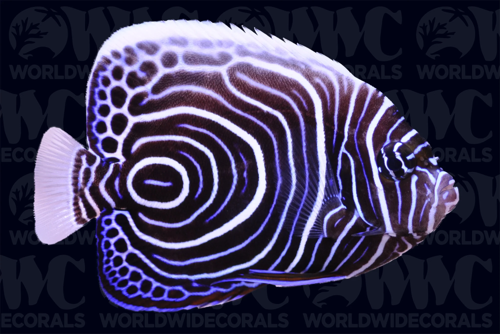
Appearance
Holacanthus bermudensis has a deep, oval-shaped body that is strongly lateral compressed. It has a short snout with a small mouth that contains small teeth, like the bristles of a brush.

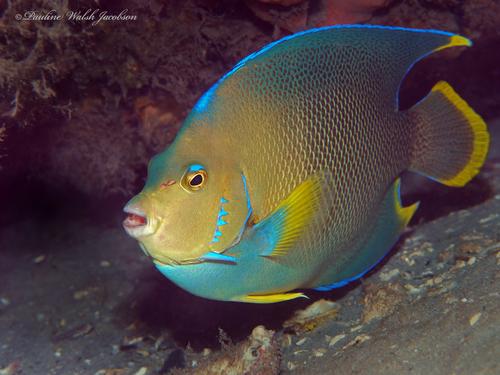
Holacanthus bermudensis, Goode, 1876
Holacanthus bermudensis, also known as the blue angelfish or Bermuda blue angelfish, is a species of ray-finned fish, a marine angelfish belonging to the family Pomacanthidae. It occurs in the western Atlantic Ocean.
Holacanthus bermudensis has a deep, oval-shaped body that is strongly lateral compressed. It has a short snout with a small mouth that contains small teeth, like the bristles of a brush.
Holacanthus bermudensis is found in the western Atlantic from North Carolina to Bermuda, into the Bahamas and Florida to the Gulf of Mexico, and also to Yucatan, Mexico in the west and east to Puerto Rico and the Virgin Islands.
Holacanthus bermudensis is a benthic species, living close to the seabed where there are areas of sponges, coral, or rock at depths between 2 and 93 metres (6.6 and 305.1 ft). It is a diurnal species, active in daylight and hiding within the reef at night. Juveniles prefer more sheltered area such as bays, channels, and inshore reefs.
The adults of the blue angelfish are usually encountered in pairs and they remain in these pairs all year. This has been interpreted as meaning that they are monogamous. When breeding they spawn by slowly swimming upwards in the water column, moving their abdomens together, and releasing copious amounts of ova and milt. The female may lay between 25 and 75 thousand eggs at a time and up to 10 million eggs in each spawning season. Each of the transparent, pelagic eggs contains a small quantity of oil as a buoyancy aid.
No dive sites list Blue Angelfish yet. Explore the map to find sites near you.