
← All marine life
Species

Blacktail Seabream

Diplodus sargus capensis, (Smith, 1844)

marinebrackish

About Blacktail Seabream

Diplodus sargus, the sargo, common white seabream, or white seabream is a species of marine ray-finned fish belonging to the family Sparidae, which includes the seabreams and porgies. This fish is found in the eastern Atlantic Ocean and in the Mediterranean Sea. It is a target species for commercial fisheries and is grown in aquaculture. D. sargus sensu lato was formerly thought to be a widespread species in the eastern Atlantic and western Indian Oceans but the taxa outside of D, sargus sensu stricto are now recognised as valid species and are part of the D. sargus species complex.

Appearance

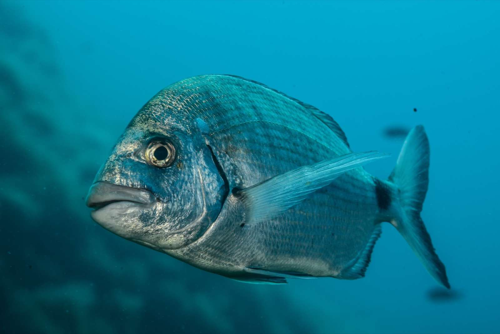
Diplodus sargus has a deep, somewhat compressed body with a high, arched back. The cheeks and gill cover are scaled. The mouth is terminal with thin lips and slightly protrusible jaws. At the front of each jaw there are 8, occasionally 10 in the upper jaw, incisor-like teeth with several rows of molar-like teeth behind them. There are 11 or 12 spines, typically 12, and between12 and 16 soft rays supporting the dorsal fin while the anal fin is supported by 3 spines and 12 to 14 soft rays. The caudal fin is forked. The overall colour is silvery-grey, the front of the head being darker. There are 9 vertical bars, these alternate between very dark and lighter bars but there may be only dark bars or none. There is a dark saddle-like blotch on the caudal peduncle, immediately to the rear of the last soft rays of the dorsal fin. There is a black spot above the base of the pectoral fin.
Habitat

Duiplodus sargus is found in the northeastern Atlantic from the southern Brittany, the Bay of Biscay and the Atlantic coasts of Spain and Portugal into the Strait of Gibraltar and throughout the Mediterranean and Black Sea. It is replaced off the coast of Israel by D. levantinus. In the eastern Atlantic this species has been moving north and has been recorded in the Channel Islands. The white sea bream is a benthopelagic, schooling species inhabiting coastal areas with rocky bottoms interspersed with sand from 0 to 150 m (0 to 492 ft), being most numerous in the surf zone. The young occur in Zostera beds and this species uses estuaries as nursery areas.

Humans & conservation

Diplodus sargus is commercially fished, with 3,713 tonnes taken in 2008. The white seabream is mostly landed by artisanal fishers and is caught using fish traps, gill nets and handlines. It is caught as bycatch in shrimp trawls. There have been a number of trials to see if this species has potential for aquaculture in the Mediterranean but this has proved to be difficult because this species grows slowly after its first year and this slow growth can impact the profitability of any commercial aquaculture.

Since the 1990s some cooked white seabream is rubbery and inedible, not related freshness or preserving. Researchers refer to this as the abnormally tough specimen (ATS) phenomenon. The cause is unknown but it seems to occur around polluted areas, with the pollutants including copper, used in anti-fouling paints.

Part of

Where to see it

No dive sites list Blacktail Seabream yet. Explore the map to find sites near you.

Sources