← All marine life
Blacknose Shark
Species IUCN · Endangered (EN)

Blacknose Shark

Carcharhinus acronotus, (Poey, 1860)

marine

About Blacknose Shark

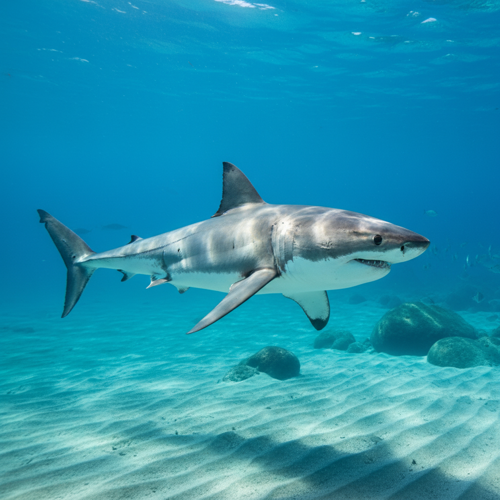
The blacknose shark (Carcharhinus acronotus) is a species of requiem shark, belonging to the family Carcharhinidae, common in the tropical and subtropical waters of the western Atlantic Ocean. This species generally inhabits coastal seagrass, sand, or rubble habitats, with adults preferring deeper water than juveniles. A small shark typically measuring 1.3 m (4.3 ft) long, the blacknose has a typical streamlined "requiem shark" shape with a long, rounded snout, large eyes, and a small first dorsal fin. Its common name comes from a characteristic black blotch on the tip of its snout, though this may be indistinct in older individuals.

Blacknose sharks feed primarily on small bony fishes and cephalopods, and in turn fall prey to larger sharks. Like other members of their family, they exhibit a viviparous mode of reproduction in which the developing embryos are sustained by a placental connection. The females give birth to three to six young in late spring or early summer, either annually or biennially, after a gestation period of eight to 11 months. This species is not known to attack humans, though it has been documented performing a threat display towards divers. It is of moderate commercial and recreational importance. In 2009, the U.S. National Oceanic and Atmospheric Administration announced the populations of the blacknose shark off the United States are being overfished, and proposed new conservation measures.

Appearance

The blacknose shark has a slender, streamlined body with a long, rounded snout and large eyes. A well-developed flap of skin occurs in front of each nostril, defining the inflow and outflow openings. Twelve to 13 and 11 to 12 tooth rows occur on either side of the upper and lower jaws, respectively, with one or two teeth at the symphysis (middle). The teeth are triangular and oblique, with serrated edges; the upper teeth are stouter than the lower teeth. The five pairs of gill slits are short, measuring less a third the length of the first dorsal fin base.

Habitat

The blacknose shark inhabits the continental and insular shelves off the eastern coast of the Americas, as far north as North Carolina and as far south as southern Uruguay, including the Bahamas, the Gulf of Mexico, and the Caribbean Sea. They frequent coastal waters over beds of seagrass, sandy flats, and shell or coral rubble. This species is spatially segregated by size and sex. Generally, only young sharks are encountered in shallow water, as the adults prefer depths greater than 9 m (30 ft) and is most common at 18–64 m (59–210 ft). Blacknose sharks in the South Atlantic Bight (off the Atlantic coast of the southern United States) migrate northward in the summer and southward (or possibly offshore) in the winter; a similar migration occurs for sharks in the Gulf of Mexico.

Behaviour

A small, fast-swimming predator, the blacknose shark feeds primarily on small, bony fishes, including pinfish, croakers, porgies, anchovies, spiny boxfish, and porcupinefish, as well as on octopus and other cephalopods. When competing for bait, their speed allows them to snatch food from larger sharks such as the Caribbean reef shark (C. perezi). This species may form large schools that are sometimes associated with anchovies and mullet. Blacknose sharks demonstrate a high degree of philopatry: both juveniles and adults have been documented returning to the same local area year after year.

Humans & conservation

The blacknose shark has never been implicated in an attack on humans. However, caution should be exercised if it begins to perform a threat display. This species is regarded as a game fish and offers a respectable fight on light tackle (a more delicate fishing line). It is also of regional commercial importance, being taken intentionally and as bycatch via gillnets and surface longlines across its range, most significantly off southwestern Florida, Venezuela, and Brazil; the meat is sold dried and salted. Large numbers of blacknose sharks are also caught incidentally by shrimp trawlers, which may pose a greater threat to its population, as many of the sharks taken are immature.

Part of

Where to see it

No dive sites list Blacknose Shark yet. Explore the map to find sites near you.