
← All marine life
Blackmouth Catshark
Species IUCN · Least Concern (LC)

Blackmouth Catshark

Galeus melastomus, Rafinesque, 1810

marine

About Blackmouth Catshark

The blackmouth catshark (Galeus melastomus) is a species of deepwater catshark, belonging to the family Pentanchidae, common in the northeastern Atlantic Ocean from Iceland to Senegal, including the Mediterranean Sea. It is typically found over the continental slope at depths of 150–1,400 m (490–4,590 ft), on or near muddy bottoms. The youngest sharks generally inhabit shallower water than the older juveniles and adults. This slim-bodied species is characterized by the black interior of its mouth, a marbled pattern of pale-edged brownish saddles or blotches along its back and tail, and a prominent saw-toothed crest of enlarged dermal denticles along the upper edge of its caudal fin. It reaches lengths of 50–79 cm (20–31 in), with sharks in the Atlantic growing larger than those in the Mediterranean.

Slow-swimming but active, the blackmouth catshark is a generalist that preys on a wide variety of crustaceans, cephalopods, and fishes. Its visual and electroreceptive systems are adept at tracking moving, bioluminescent prey. This species is oviparous, with females producing batches of up to 13 egg cases throughout the year. Because of its abundance, the blackmouth catshark forms a substantial part of the bycatch of deepwater commercial fisheries across much of its range. It has low economic value and is usually discarded, though the largest sharks may be marketed for meat and leather. The International Union for Conservation of Nature (IUCN) has listed this species under Least Concern, as there is no indication that its numbers have declined despite fishing pressure.

Appearance

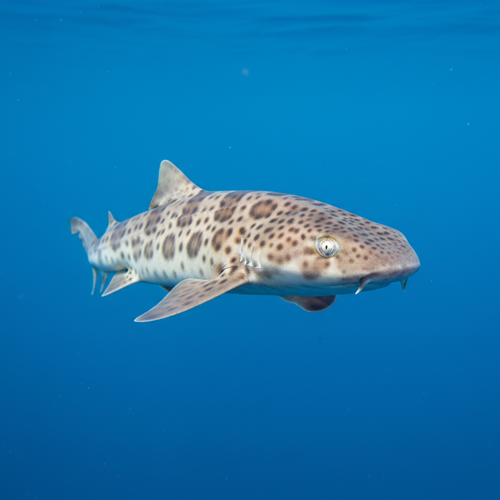
The reported maximum lengths attained by the blackmouth catshark varies from 67 to 79 cm (26 to 31 in) for Atlantic sharks and 50 to 64 cm (20 to 25 in) for Mediterranean sharks; a length record of 90 cm (35 in) may be dubious. Females attain a larger ultimate size than males. The maximum weight on record is 1.4 kg (3.1 lb). This species has a slender, firm body with a rather long, pointed snout comprising roughly 6–9% of the total length. The anterior rim of each nostril bears a large triangular flap, which divides the nostril into incurrent and excurrent openings. The eyes are horizontally oval and equipped with rudimentary nictitating membranes (protective third eyelids). Beneath each eye is a subtle ridge, and behind is a small spiracle. The mouth forms a short, wide arch, and bears moderately long furrows around the corners.
Habitat

The blackmouth catshark is widely distributed in the northeastern Atlantic Ocean, from southwestern Iceland and Trondheim, Norway southward to Senegal, including the Faroe Islands, the British Isles, the Azores, and the northern portion of the Mid-Atlantic Ridge. It occurs throughout the Mediterranean Sea, save for the northern waters of the Adriatic and Aegean Seas, and is absent from the Black Sea. This species primarily inhabits the continental slope, at depths of 150–1,400 m (490–4,590 ft). However, it has been documented from water as shallow as 20–25 m (66–82 ft) in Norway, and as deep as 2,300–3,850 m (7,550–12,630 ft) in the eastern Mediterranean.

Diet

The blackmouth catshark is an active, generalist predator that feeds on both bottom-dwelling and free-swimming organisms. Its diet is dominated by decapods, krill, bony fishes (including lanternfishes, bristlemouths, dragonfishes, and moras), and cephalopods. The most significant prey species generally reflect what is most available in the environment, for example the shrimps Calocaris macandreae and Pasiphaea multidentata off southern France and the prawns Sergestes arcticus and Sergia robusta off the Iberian Peninsula. Juveniles consume a greater amount and variety of crustaceans than adults, including smaller types such as mysids and hyperiid amphipods. Adults favor relatively large fish prey and have been known to take other sharks and rays and smaller members of the same species. The importance of cephalopod prey across ages differs between regions.

Behaviour

Within its range, the blackmouth catshark is one of the most abundant sharks over the upper and middle continental slope. It is nomadic in nature and may be found alone or in groups. Relatively slow, this shark swims with strong eel-like (anguilliform) undulations of its body. It often cruises just above the sea floor, perhaps taking advantage of the ground effect (a reduction in the drag on a wing when close to the ground) to save energy. It has also been seen resting motionless on the bottom. Known predators of the blackmouth catshark include the kitefin shark (Dalatias licha) and the European flying squid (Todarodes sagittatus). Parasites that have been documented from this species include the tapeworm Ditrachybothridium macrocephalum and the protist Eimeria palavensis.

Humans & conservation

Harmless to humans and of little economic value, the blackmouth catshark is caught incidentally in large numbers by commercial bottom trawl and longline fisheries. In particular, it is among the most commonly bycaught sharks in trawls targeting deepwater lobsters and shrimps (Nephrops norvegicus, Parapenaeus longirostris, Aristeus antennatus, and Aristaeomorpha folicea), operating off Portugal and in the Mediterranean. Most captured sharks are discarded, probably with heavy mortality. Some fisheries, such as those off Portugal and Italy, retain and utilize a small subset of the largest individuals for human consumption fresh or dried and salted, and for leather; the fishing fleet of Viareggio, Tuscany reported landing 700 kg (1,500 lb) in 2005. In the northeastern Atlantic, this shark is being increasingly targeted by fishers following the decline of other deepwater shark species.

Part of

Where to see it

No dive sites list Blackmouth Catshark yet. Explore the map to find sites near you.