
← All marine life
Blackfin Barracuda
Species IUCN · Least Concern (LC)

Blackfin Barracuda

Sphyraena qenie, Klunzinger, 1870

marine

About Blackfin Barracuda

The blackfin barracuda (Sphyraena qenie), also known as the chevron barracuda, is known for its aggressive, predatory personality.

Appearance

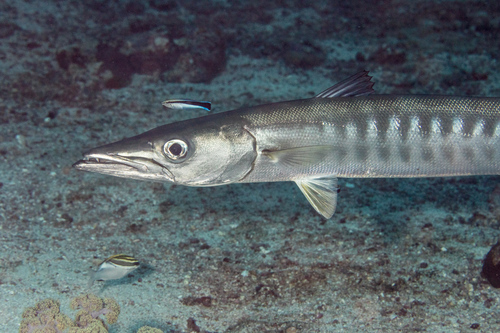
The blackfin barracuda reaches a maximum size of 140 cm (55 in). The blackfin barracuda is known for its long black lateral bands that go around its body. These bands extend laterally down the torso and are v-shaped with the apex facing to the front. There are about 18 to 22 bands that are on the fish's body. The number of bands sets them apart from similar species, the S. jello and S. putnamae.

It has elongated last rays on the second dorsal fin and anal fins and a blackish caudal fin.

One of the most distinct features of this species of barracuda is that they lack gill rakers.

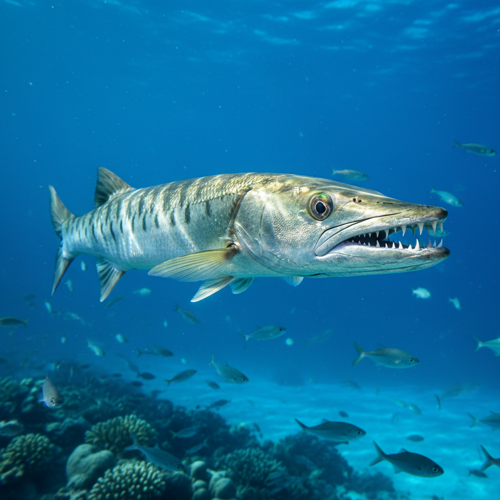
As for their mouths, the maxilla, or upper jaw, goes in a vertical line through the front of their eyes and the lower jaw, which is longer than the upper jaw. This upper jaw has a conical tip that is distinct to this species. Next to the mouth, their preopercle does not have a skinny flap, as most others do.
Habitat

This species of barracuda ranges from the Red Sea and East Africa to the Indo and Western Pacific and as far as French Polynesia and typically live in tropical and temperate waters. The Indo-Pacific Ocean has tropical and subtropical waters that make it a favorable habitat for S. qenie. The first sighting of this species in Indian waters was in 1966.

Although rare, this species can also be found in the tropical East Pacific.

In Japan, they can be found in the waters around Ryukyu, Amami Oshima, Yonaguni, Tanega, and Ishigaki Islands. For Ryukyu Island, only the adults migrate there from tropical waters when temperatures are too high. Additionally, during the summer seasons, they have also been spotted near Okinoerabu Island waters from July to October.

Humans & conservation

S. qenie is not a favorable sport fish, but is used for forms of longline fishing. Its delicate flesh is flavorful, making it desirable as bait, especially for catching tuna. It is usually caught at night by trawling, but for this reason, is not commonly spotted in American Samoa.

In a study conducted in remote Oceania to find levels of Mercury (Hg) in coral reef systems, S. qenie played an important role in indicating the amounts of Hg in remote ecosystems. It was found that by world health standards, levels of Mercury were high in reef predators that live in the waters that weren't impacted and that eating these top-trophic reef fish might have to be warranted at the time.

Part of

Where to see it

No dive sites list Blackfin Barracuda yet. Explore the map to find sites near you.