
← All marine life
Black-Spot Angelfish
Species IUCN · Least Concern (LC)

Black-Spot Angelfish

Genicanthus melanospilos, (Bleeker, 1857)

marine

About Black-Spot Angelfish

Genicanthus melanospilos, the spotbreast angelfish, blackspot angelfish or swallowtail angelfish, the family Pomacanthidae. It occurs in the Indo-West Pacific region.

Appearance

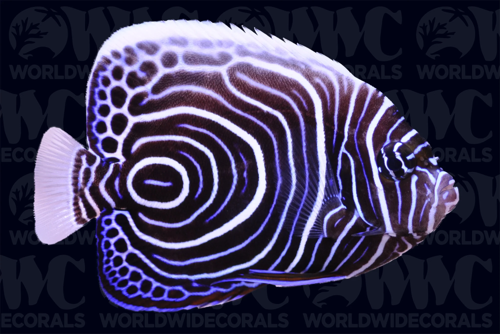
Genicanthus melanospilos shows sexual dichromatism, the males and females have differing colouration. The males have a background colour of bluish white on the body with many reddish black vertical stripes. Their dorsal, caudal and anal fins are marked with yellow spots and the caudal fin is light yellow with blue margins and has long filamentous lobes. They also have a sizeable black spot on the breast near the base of the pelvic fins. In the females the dorsal half of the body is yellow, while ventrally it is bluish white, and the tail is bluish with a black stripe along its lower and upper margins. In both sexes the forked tail narrows at its base to create a "swallow tail". The dorsal fin contains 15 spines and 15-17 soft rays while the anal fin has 3 spines and 17-18 soft rays. This species attains a maximum total length of 18 centimetres (7.1 in).
Habitat

Genicanthus melanospilos is a widespread species which is found in the eastern Indian Ocean and the western Pacific Ocean. It is found throughout the Malay Archipelago into the southwestern Pacific Ocean as Far East as Fiji, north as far as the Ryukyu Islands south to Australia. In Australian waters it is found in the Indian Ocean of the Cocos (Keeling) Islands and Christmas Island, as well as the Ashmore Reef in the Timor Sea and the Great Barrier Reef off the coast of Cairns in Queensland .

Part of

Where to see it

No dive sites list Black-Spot Angelfish yet. Explore the map to find sites near you.