
← All marine life
Black Musselcracker
Species IUCN · Vulnerable (VU)

Black Musselcracker

Cymatoceps nasutus, (Castelnau, 1861)

marinebrackish

About Black Musselcracker

The black musselcracker (Cymatoceps nasutus) is a species of marine ray-finned fish belonging to the family Sparidae, which includes the seabreams and porgies. This species is the only species in the monospecific genus Cymatoceps. It is endemic to South Africa.

Appearance

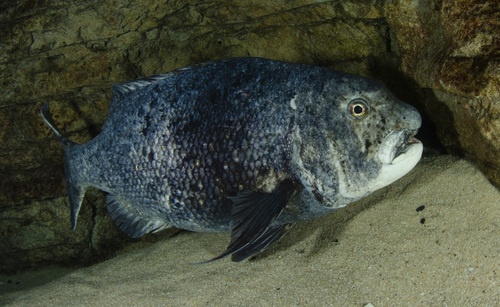
The black musselcracker is distinguished from other genera in the Sparidae by having scales on the area between the eyes and on the bases of the soft rayed parts of the dorsal and anal fins. The flange on the preoperculum is partially covered with scales. The dorsal fin is supported by 12 spines and 10 soft rays while the anal fin is supported by 3 spines and 9 soft rays. The body is moderately deep and compressed, its standard length being between 2.3 and 2.5 times its depth. The dorsal profile of the head is gently sloping but in large adults develop a fleshy process on the snout and a hump before the eyes. The scales are ctenoid, larger below the lateral line than above it. The overall colour of adults is dull dark grey with the chin and belly being bright white> The juveniles are dark greenish brown in colour on the body with irregular white mottling.
Habitat

The black musselcracker is endemic to South Africa where it is found from northern KwaZulu-Natal to False Bay. It has been reported from Maputo Bay in Mozambique but it is unknown from line or trap fisheries in Maputo. It is found at depths between 1 and 80 m (3 ft 3 in and 262 ft 6 in) and occurs in shallow rocky areas, rarely entering estuaries.

Humans & conservation

The black musselcracker is a popular sport fish in South Africa. Because it is eagerly sought after, this species experiences a lot of over harvesting, which diminishes its chances of a stable population. The reason that black musselcracker is vulnerable to over harvesting is mainly because they have a slow growth rate, which means that they are most likely being harvested before they are old enough to reproduce.

As a result of over harvesting the black musselcracker, there are now fishing regulations to protect this species. The primary rule is that each fisherman is allowed only one fish, minimum length of 50 centimeters, per day. Because of these new regulations, in some regions of South Africa, black musselcracker populations are on the rise.

Part of

Where to see it

No dive sites list Black Musselcracker yet. Explore the map to find sites near you.