
← All marine life
Black Marlin
Species IUCN · Data Deficient (DD)

Black Marlin

Istiompax indica, (Cuvier, 1832)

marine

About Black Marlin

The black marlin (Istiompax indica) is a species of marlin found in tropical and subtropical areas of the Indian and Pacific Oceans approximately between 40 degrees North and 45 degrees South, while in some instances venturing into more temperate waters. Reaching lengths of over 4.5 m (15 ft), it is one of the largest marlins and also one of the largest bony fish. Marlins are among the fastest fish, but speeds are often exaggerated in popular media, such as reports of 129 km/h (80 mph). A 2016 study estimated maximum swimming speeds from muscle contraction times, which in turn limit the tail-beat frequency; the study suggested a theoretical upper limit for the black marlin's burst speed of 36 km/h (22 mph).

Black marlin are fished commercially and are also a highly prized game fish. Black marlins were known to drag ancient Maldivian fishing boats for very long distances after being hooked, until the marlins finally tired; it would take many hours for the fishermen to row or sail back home. Due to the common misidentification of large billfish such as the black marlin, as well as its highly migratory habits and the lack of research into the species, much about populations are unknown. The species was first known as Tetrapturus indicus and later was reclassified as Makaira indica before taking on its current scientific name. One of the earliest scientific records of black marlin is its description by French zoologist Georges Cuvier in 1832.

Appearance

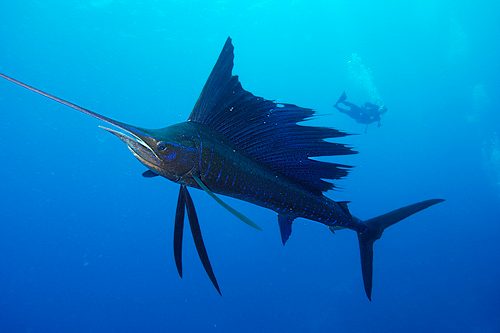
Compared to striped or white marlins and sailfish, black marlins are more solid than their blue counterparts. They have a shorter, heavier bill and a rounder and lower dorsal fin. Black marlin may be distinguished from all other marlin species by their rigid pectoral fins, which, especially from a weight of around 68 kg (150 lb), are unable to be pressed flat against their sides but can be tilted further backwards for reduced drag. The black marlin showcases an extremely chrome underside and a dark blue-black dorsal side, the two colored layers are often separated by a yellow-ish chrome stripe. The black marlin is the only istiophorid in which the second dorsal fin is anterior to the second anal fin, this feature holds for all sizes. Black marlin are measured like other bill fish from the tip of their lower jaw to the fork of their tail.
Habitat

Black marlins spend more time closer to the surface than most other billfish, except for sailfish. Scientists found in one population of black marlin that at night the fish would spend up to 87% of their time at depths above 30 meters deep, but during the day less than 60% of their time was spent in the upper 30 meter depths of the sea. Because of this, black marlin distribution is influenced by the surface height of the ocean throughout the time of year. Black Marlin live in temperatures from 15 degrees Celsius to 30 degrees Celsius. Juvenile black marlin around Australia utilize the great barrier reef lagoon as an area to grow and develop due to an abundance of resources. During the younger life stages, black marlin will form seasonal aggregations (aggregation: temporary assemblage of individuals) throughout the great barrier reef lagoon.

Reproduction

Black marlin spawn at different times depending on their location. Spawning around southern Asia has been observed in May and June, around Taiwan from March through April as well as from August to October, and around Australia between October and December. Spawning has also been noted from August to November around northern Australia. Black marlin are believed to prefer water temperatures around 27° to 28°C during spawning. Egg counts of ripe roe totaled about 40 million per female.

Humans & conservation

The conservation status of the black marlin is unknown. Due to the migratory nature of these fish and a lack of research, the population size and health cannot be accurately stated. Research into black marlin runs into many complications regarding finding them consistently. One such problem is that they are particularly good at ditching their trackers. The Billfish Conservation Act was passed in 2012 and has been amended as recently as 2018 outlawing the sale of billfish throughout the United States (except swordfish), this act does not outlaw fishing for such fish but only the sale. There are currently no fisheries for black marlin.

Part of

Where to see it

No dive sites list Black Marlin yet. Explore the map to find sites near you.