
← All marine life
Black Damselfish
Species IUCN · Least Concern (LC)

Black Damselfish

Neoglyphidodon melas, (Cuvier, 1830)

marine

About Black Damselfish

Neoglyphidodon melas, known as the bowtie damselfish or black damselfish, is a species of tropical reef fish in the damselfish family Pomacentridae.

Appearance

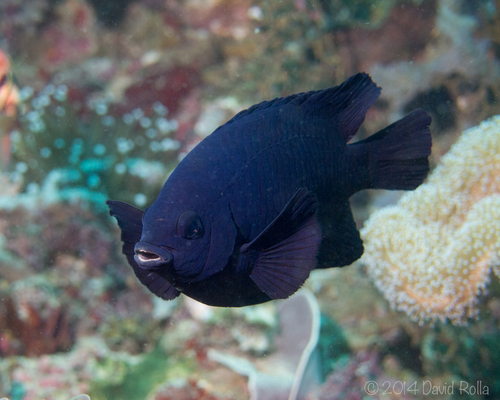
Neoglyphidodon melas may be identified by its dark blue-black coloration in adulthood. However, juveniles are pale blue with a yellow stripe across their dorsal surface, and sport yellow-lined caudal fin rays and bright blue anal and pelvic fins with dark outer rays. Neoglyphidodon melas possesses 13 dorsal spines, 13–15 soft dorsal rays, 2 anal spines, and 12–15 soft anal rays. The body is laterally compressed, allowing this species to navigate through tight crevices in coral reefs, while their long pectoral fins further aiding in maneuverability and agility. Neoglyphidodon melas may grow to 11.8–18 cm and reach 100 g at maturity.

Habitat

Neoglyphidodon melas may be found throughout the Indo-Pacific region, with sightings in the Red Sea, East Africa, the Indo-Malayan archipelago, the Ryukyu Islands, China, the Philippines, Palau, New Guinea, the Solomon Islands, Vanuatu and northern Australia.

Within these seas, this species is found in coralline, rocky lagoons, as well as marine reefs that contain soft corals, which constitute the majority of their diets. It is most commonly found between depths of 1–12 m.

Diet

Bowtie damselfish are an important prey organism of many higher trophic level fish, including the coral grouper (Plectropomus leopardus), which is important to the local fishing industries of the Indo West Pacific.

Behaviour

This species creates unique pairings during mating, although the timing of such events has not been observed. After forming a pair, the female bowtie damselfish lays her eggs, adhering them with a sticky substance to a flat reef surface such as a ledge, rock or a shell. After this, the female departs, and the male stays to defend the eggs from predation. During this time, the male frequently aerates the eggs with his fins until hatching occurs, typically 3–7 days after fertilization.

Humans & conservation

Neoglyphidodon melas has become a key recreational species on the Seribu Islands, where they are commonly caught as bycatch in fishing pots. Locals prefer larger and more profitable species in the area such as groupers, but this species is often caught as well. Due to their small size, only the large adults are edible. Any Neoglyphidodon melas under this edible limit are either returned from docks post-catch, or discarded posthumously. Individuals released after bycatch have a high risk of mortality due to prolonged air-exposure, improper handling, and relocation to unsuitable habitats. As seen in locations like the Red Sea, stress from catch may leave the bowtie damselfish vulnerable for infections such as the case with T. maritimus.

Part of

Where to see it

No dive sites list Black Damselfish yet. Explore the map to find sites near you.