
← All marine life
Black Croaker
Species IUCN · Data Deficient (DD)

Black Croaker

Cheilotrema saturnum, (Girard, 1858)

marine

About Black Croaker

Cheilotrema saturnum, the black croaker, China croaker or corvina roncacho, is a demersal species of sciaenid croaker found in the nearshore habitats of the Southern California Bight and Baja California.

Appearance

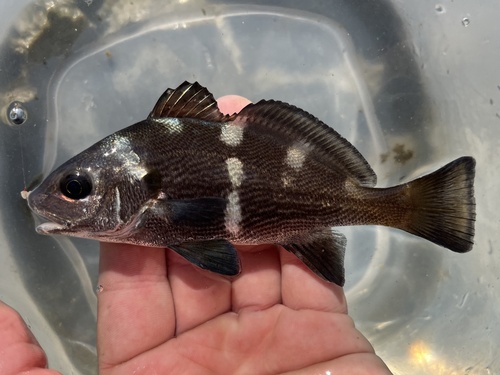
Black croakers have compressiform bodies with an inferior mouth and a truncate tail. As adults, fish are mostly black with a silver ventral side. Often, 3-5 blotches are typically present on the dorsal surface of the fish, with a vertical white stripe running down from the margin between the two dorsal fins. In many cases, additional vertical stripes or blotches on the sides may be observed. The fins of adults range from clear to black.

As juveniles, black croakers are slightly more fusiform compared to the adults. They are colored silver with 3-6 horizontal black stripes reaching across the length of their body.

Habitat

Black croakers are found from the northern reaches of the Southern California Bight to the southern stretch of the Baja California Peninsula and the northern portions of the Sea of Cortez. Within the Southern California Bight, they are very abundant in the mainland's nearshore habitats but occur far less frequently at Catalina Island. Populations are concentrated near rocky headlands of the coast, such as Palos Verdes.

Behaviour

Black croakers may be found at depths ranging from the surface to about 45m deep, though they most frequently occur at 3-15m. Black croakers have a propensity for rocky habitats, and are found more often in rocky reefs than kelp forests. During the summer, adults are occasionally observed over sand patches. Habitat choice may change based on the water conditions. Fish are more likely to be found in caves and underwater structures during periods of low turbidity, but may be observed 3 meters off the sea floor when visibility is low.

Reproduction

The spawning season for black croakers is typically late spring to summer, with the peak of spawning occurring during midsummer. Females appear to release mature eggs continuously throughout the spawning season. There is relatively less recruitment during cold water years.

Humans & conservation

Despite being an abundant and ecologically-important species in its range, black croakers are not the target of any recreational or commercial fishery. Hook-and-line fishermen occasionally catch them off the Southern California coast. In northern Baja California, they are a minor component of the local artisanal fishery.

Part of

Where to see it

No dive sites list Black Croaker yet. Explore the map to find sites near you.