← All marine life
Black Coral
Group

Black Coral

Antipatharia

marinebrackish

About Black Coral

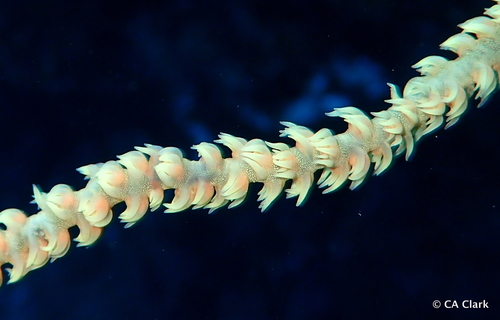
Antipatharians, also known as black corals or thorn corals, are an order of soft deep-water corals. These corals can be recognized by their jet-black or dark brown chitin skeletons, which are surrounded by their colored polyps (part of coral that is alive). Antipatharians are a cosmopolitan order, existing in nearly every oceanic location and depth, with the sole exception of brackish waters. However, they are most frequently found on continental slopes under 50 m (164 ft) deep. A black coral reproduces both sexually and asexually throughout its lifetime. Many black corals provide housing, shelter, food, and protection for other animals.

Black corals were originally classified in the order Ceriantipatharia along with ceriantharians (tube-dwelling anemones), but were later reclassified under Hexacorallia. Though they have historically been used by Pacific Islanders for medical treatment and in rituals, its only modern use is making jewelry. Black corals have been declining in numbers and are expected to continue declining due to the effects of poaching, ocean acidification and climate change.

Appearance

The skeletons of these corals grow in many patterns unique to this order, such as whips, trees, fans, or coils. These range in size from 10 to 300 cm (3.94 to 118 in), though polyps can be as small as 1 mm (0.0394 in) in size. Skeletons are also lined with tiny spikes. These spikes are roughly 0.5 mm (0.0197 in) in size, and vary widely in terms of size, length, proportion, and sharpness. A layer of "bark" forms around the skeleton as the coral grows. The polyps that live inside this bark are less than 2 mm (0.0787 in) and are gelatinous and have six tentacles (the same as hard corals and unlike soft corals, which have eight). These polyps can be nearly any color. Some corals also have "sweeper tentacles", which can grow up to 15 mm (0.591 in) long. Though individual polyps are either male or female, entire colonies are typically hermaphroditic.

Diet

Black corals are carnivorous, with the coral's polyps allowing it to feed mostly on meiofauna such as zooplankton. Cnidarians have an oral disk in their center which serves as the polyp's mouth; this disk is surrounded by tentacles, which stings and digests food. The reason many corals are fan-shaped is to catch meiofauna. Many corals only have polyps on the downstream side of the coral, allowing them to catch nearly the same number of animals without wasting energy keeping unnecessary polyps alive.

Behaviour

Black corals occur throughout all the oceans from the surface down to the deep-sea, though nearly 75% of species are only found at depths below 50 m (164 ft). The sole oceanic area in which black corals have not been found are brackish waters, though they can inhabit areas with decreased salinity. Black corals are found on reefs, and may contribute to overall reef building, but are also often found as solitary colonies on isolated outcroppings. Most individuals require a hard surface for attachment. They will frequently grow where undersea currents flow, which allows them to feed on the meiofauna that is swept by. Since undersea currents benefit the corals, they will often grow on or by geographic structures that cause currents, such as continental slopes, cliffs, caves, or undersea plateaus.

Reproduction

Due to the slow life cycle and deep-water habitats of black coral, little is known about their life cycle and reproduction. As with other cnidarians, the life cycle of these corals involves both asexual and sexual reproduction. Asexual reproduction (also known as budding), is the first method of reproduction used by a black coral during their lifespan. Once a polyp is anchored, it builds a colony by creating a skeleton, growing new branches and making it thicker, similar to the growth of a tree. This method of growing creates "growth rings" which can be used to estimate the age of a colony. Asexual reproduction can also occur if a branch breaks off and a replacement is needed. Though light is not required for growth or development, mature colonies will grow towards light. Why they do so is unknown.

Humans & conservation

Black corals have historically been associated with mystical and medicinal properties in Indonesian, Chinese, and Hawaiian culture. More recent harvesting has been for use as jewelry. Many Indo-Pacific peoples believed that black coral has curative and anti-evil powers and made them into necklace and bracelets; however, black corals are not ideal for jewelry-making due to it being soft as opposed to stony, causing jewelry made with it to dry out and break. If a real black coral is boiled in milk, it will smell of myrrh; this test can be used to determine if a sample is genuine.

Species in this group

Where to see it

No dive sites list Black Coral yet. Explore the map to find sites near you.