
← All marine life
Black-Axil Chromis
Species IUCN · Least Concern (LC)

Black-Axil Chromis

Chromis atripectoralis, Welander & Schultz, 1951

marine

About Black-Axil Chromis

The black-axil chromis (Chromis atripectoralis), also known as the blackfin chromis or blue-green puller, is a damselfish from the tropical Indo-Pacific. This fish can reach almost 12 centimetres (4.7 in) in length. It inhabits lagoons and reefs after settlement in the late-larval stage, and often occurs in large numbers, feeding above Acropora corals. This fish mostly feeds upon copepods, amphipods, and zoea.

This fish is often confused with its sibling species Chromis viridis.

Appearance

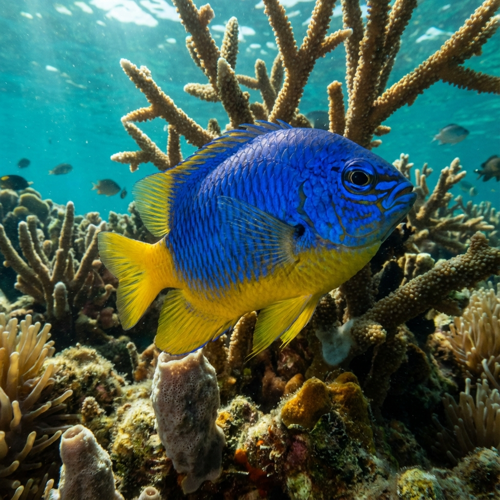
C. atripectoralis is a blue-green damselfish that grows to a maximum length of twelve centimeters. The head and dorsal side of the fish is blue-green, while the belly is white to white-gray. C. atripectoralis has both an inner and an outer row of conical, widely spaced teeth.
Habitat

The range of C. atripectoralis spans the Indian and south Pacific Oceans from the east African coasts to French Polynesia, and the damselfish can also be found as far north as the Ryukyu Islands of Japan in the north Pacific. The habitat of C. atripectoralis overlaps with that of its sibling species C. viridis, although C. viridis can additionally be found in the Red Sea.

Behaviour

C. atripectoralis is an oviparous species whose eggs are laid into the water to hatch at a later time. The late-stage larvae of C. atripectoralis reside in the pelagic zone and exhibit a swimming speed range of 21.6 to 25.2 centimeters per second. The late-stage larvae exhibit directionality in their swimming, although there is more variation in directionality in leeward trajectories than in windward trajectories. Additionally, the late-stage larvae of C. atripectoralis exhibit greater variation in their swimming directionality during afternoons with cloudy conditions than in sunny conditions. This suggests that the larvae may use a solar compass to guide their movements. The overall swimming directionality of late-stage C. atripectoralis appears to be southeast in the morning and south-southwest in the afternoon, regardless of where the nearest shore is located.

Part of

Where to see it

No dive sites list Black-Axil Chromis yet. Explore the map to find sites near you.