
← All marine life
Bigeye Snapper
Species IUCN · Least Concern (LC)

Bigeye Snapper

Lutjanus lutjanus, Bloch, 1790

marine

About Bigeye Snapper

The bigeye snapper (Lutjanus lutjanus), also known as the bigeye seaperch, red sea lined snapper, golden striped snapper, rosy snapper, yellow snapper, or simply snapper, is a species of marine ray-finned fish, a snapper belonging to the family Lutjanidae. It is native to the Indian Ocean and the western Pacific Ocean. It is the type species of the genus Lutjanus.

Appearance

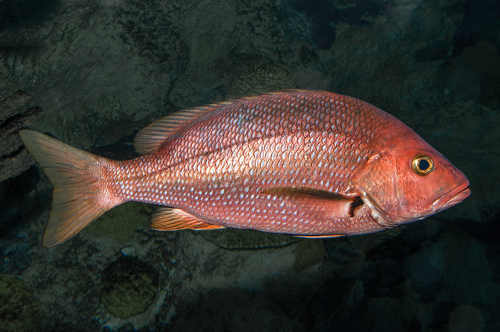
The bigeye snapper has a fusiform, slender body which has a standard length that is 2.9 to 3.3 as long as the body's deepest points. It has a gently sloped forehead and the preopercular incision and knob are weakly developed. The vomerine teeth are arranged in a triangular patch with a central rearwards extension and the tongue has a patch of grain-like teeth. The dorsal fin has 10-12 spines and 12 soft rays while the anal fin contains 3 spines and 8 soft rays. The rear of the dorsal fin and the anal fin have an angular profile, the pectoral fins have 16-17 rays and the caudal fin is truncate or weakly emarginate. This fish attains a maximum total length of 35 cm (14 in). The upper back is golden-brown in colour with silvery-white flanks with a brown to yellow stripe running from the snout to the dorsal caudal peduncle.
Habitat

The bigeye snapper has a wide Indo-West Pacific distribution. It is found from the Red Sea and the eastern African coast as far south as South Africa and Madagascar east along the southern Asian coast, including the Seychelles, into the Pacific where it has been recorded from Tonga and Wallis Island. It extends north to Japan and south to Australia. In Australian waters it has been recorded from the coasts north-western Western Australia around the tropical northern coast to the northern coast of Queensland. It is found at depths between 1 and 96 m (3 ft 3 in and 315 ft 0 in) in areas of coral reef and inshore waters with soft substrates.

Humans & conservation

The bigeye snapper caught using handlines and bottom trawls in some parts of its range, it is also caught as a bycatch in shrimp fisheries. The catch is sold fresh and it can be a common species in fish markets. Between 1979 and 1982 2,286 tonnes was reported to the FAO as being taken in the Gulf of Suez representing 10-20% of the annual snapper landings in that region. However, this species remains locally abundant and has stable populations so the IUCN have assessed it as Least Concern.

Part of

Where to see it

No dive sites list Bigeye Snapper yet. Explore the map to find sites near you.