
← All marine life
Bigeye Scad
Species IUCN · Least Concern (LC)

Bigeye Scad

Selar crumenophthalmus, (Bloch, 1793)

marine

About Bigeye Scad

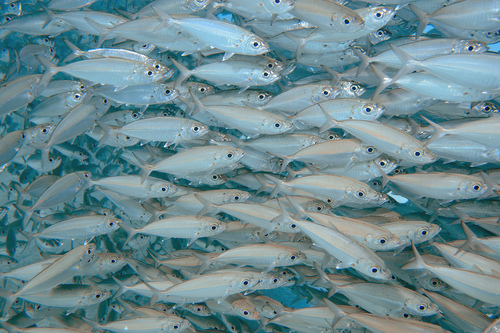
The bigeye scad or big-eyed scad (Selar crumenophthalmus) is a species of marine ray-finned fish belonging to the family Carangidae, which includes the amderjacks, trevallies and kingfishes. This fish is found in tropical regions around the globe. Other common names include purse-eyed scad, goggle-eyed scad, akule, chicharro, charrito ojón, jacks, matang baka, mushimas and coulirou. The bigeye scad is fished commercially, both for human consumption and for bait.

Appearance

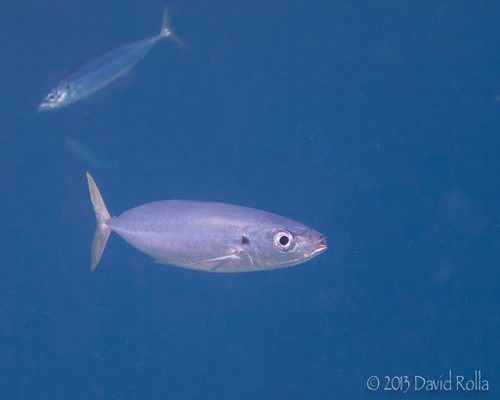
The bigeye scad has an fusiform body with a compressed cross section which reaches a maximum total length of 70 cm (28 in). The dorsal fin is supported by 9 spines and between 24 and 27 soft rays, the anal fin contains 3 spines and 21-23 soft rays. This species is metallic blue to bluish green on the upper body, fading to white on the lower body, there may be a yellow stripe running from the margin of the operculum to the upper part of the base of the caudal fin.
Habitat

The bigeye scad is a circumtropical distribution, in the Atlantic it has been recorded as far north as Nova Scotia and is found as far south as Rio de Janeiro, in the eastern Atlantic it is found from Cape Verde south to Angola, including Ascension Island. It occurs from the coast of Eastern Africa through the Indian Ocean into the Pacific as far north as southern Japan and Hawaii, south to New Caledonia and Australia. It also occurs in the Eastern Pacific from Baja California south to Peru, including the Galapagos Islands. The adults show a preferemce for clear oceanic waters in the vicinity of islands and in the open ocean, they occasionally occur in turbid waters. They are found at depths down to 170 m (560 ft).

Part of

Where to see it

No dive sites list Bigeye Scad yet. Explore the map to find sites near you.