
← All marine life
Bigbelly Seahorse
Species IUCN · Least Concern (LC)

Bigbelly Seahorse

Hippocampus abdominalis, Lesson, 1827

marinebrackish

About Bigbelly Seahorse

The big-belly seahorse (Hippocampus abdominalis) or pot-bellied seahorse is one of the largest seahorse species in the world, with a length of up to 35 cm (14 in), and is the largest in Australia. Seahorses are members of the family Syngnathidae, and are teleost fishes. They are found in south-eastern Australia and New Zealand, and are listed on Appendix II of CITES. They are the only species of seahorse found in New Zealand, with a habitat range spanning from the Three Kings Island in the north all the way to the Snares Islands in the south.

Appearance

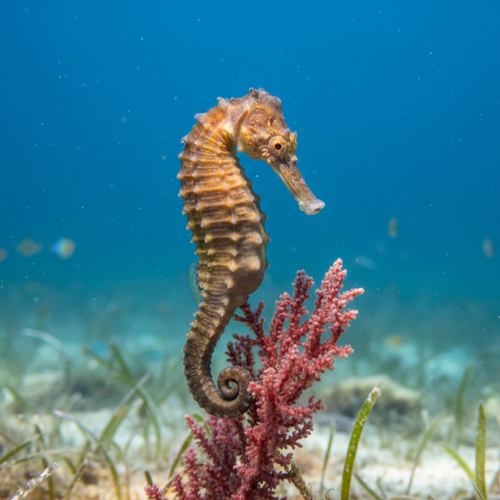
The big-belly seahorse has a forward-tilted, a long-snouted head, a distended but narrow pot belly, and a long, coiled tail. They can be yellow, brown or sometimes white in colouration. It swims using its dorsal fin with a vertical stance; when not swimming, it coils its prehensile tail around any suitable growth, such as seaweed, waiting for planktonic animals to drift by, when they are sucked up by the small mouth set at the tip of the snout much like a vacuum cleaner. Seahorses are voracious feeders, eating mainly crustaceans, such as shrimp, and other small animals living among the seaweed, such as copepods and amphipods. They do not chew, so they can eat to excess because of their small gut tract. Each eye moves separately, making it easier for them to see food and predators.
Habitat

Big-belly Seahorses (Hippocampus abdominalis) are found in both South-East Australian and New Zealand waters, typically inhabiting shallow environments such as large rock pools at low tide. They are able to remain motionless amidst seaweed which can be useful to avoid predation. These types of habitats are preferred as they are the most productive for the seahorse's ambush predation strategy

Juveniles are pelagic or attached to drifting seaweed, and adults feed on minute crustaceans like copepods and amphipods.

Diet

Adult seahorses eat 30 to 50 times a day if food is available; due to their slow consumption they must feed constantly to survive. Big-belly seahorses do not have a stomach or teeth, so they feed by sucking small invertebrates in through their bony tubular snouts with a flick of their head. Their snouts can expand if the prey is larger than their snout, allowing them to consume a variety of organisms.

Behaviour

Juvenile and adult big-belly seahorses, when given a choice, prefer vegetated areas (even with artificial seagrass) over open water. They consistently choose vegetated areas, even when mysid prey is present in adjacent clear water. This preference is linked to their predatory behaviour as they rely on ambush predation.

Reproduction

In the wild, breeding can commence when the seahorses are about one year old, and this can be reduced to about eight months when in captivity. Breeding in big-belly seahorses occurs year-round, with peaks in the warmer months.

Courtship initiation involves a series of colour changes and postural displays. Dilating the opening of the brood pouch slightly, the male inflates the pouch to balloon-like proportions with water by swimming forwards, or by pushing his body forwards in a pumping action, then closing the pouch opening. At the same time, he lightens his pouch in colour to white or light yellow. The male also brightens his overall body colouration, typically intensifying the yellow. A male repeatedly approaches his selected female with his head tucked down, and dorsal and pectoral fins rapidly fluttering.

Part of

Where to see it

No dive sites list Bigbelly Seahorse yet. Explore the map to find sites near you.