
← All marine life
Big-Scale Sand Smelt
Species IUCN · Least Concern (LC)

Big-Scale Sand Smelt

Atherina boyeri, Risso, 1810

marinebrackishfreshwater

About Big-Scale Sand Smelt

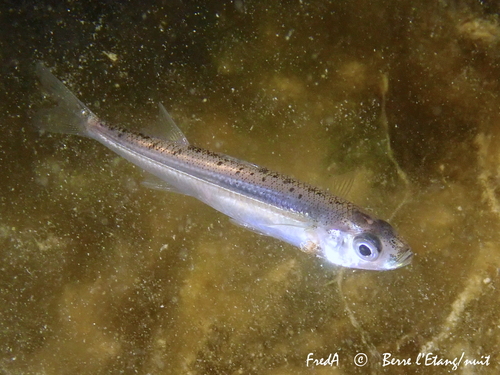
The big-scale sand smelt (Atherina boyeri) is a species of fish in the family Atherinidae. It is a euryhaline amphidromous fish, up to 20 cm in length.

Appearance

It is a small pelagic fish species which occurs near the surface in the littoral estuarine zone: in lagoons, salt marshes (77 psu), shallow brackish areas (2 psu) and inland waters which are rather unsuitable for other fish species, due to their high ionic strength and salinity.

Body is rather long, slender, moderately flattened. Eyes are large. Head and body are scaly. Mouth is protractible, upwardly directed, with small teeth. Lower jaw has an upper expansion within mouth (high dentary bone). There are two separate dorsal fins, with all rays of first and 1–2 anterior rays of second dorsal fin being unsegmented. The anal fin is similar to the second dorsal fin, while the caudal fin is forked. The first dorsal fin has 6–10 flexible spines.

It is an omnivorous species feeding on zoo-plankton and small bottom-living animals (crustacean gammarids, polychaete worms and molluscs).
Habitat

It is found in the eastern Atlantic from Portugal and Spain to Nouadhibou (Mauritania) and Madeira. Also it occurs in the Mediterranean, including the inshore lagoons, such as Trasimeno and Lesina in Italy, Hyères in the southern France such as Marseille and Lake Qarun in Egypt; an isolated population is found near the coasts of England and the Netherlands. In the Black Sea, it is widespread along all coasts, in lagoons and estuaries, in the downstreams of rivers Danube, Dniester, Southern Bug, Inhulets, and Dnieper, with a permanent population is in the Kakhovka Reservoir.

The isolated population in the Caspian Sea is characterised as subspecies A. b. caspia (Eichwald, 1838).

Part of

Where to see it

No dive sites list Big-Scale Sand Smelt yet. Explore the map to find sites near you.