
← All marine life
Bermuda Chub
Species IUCN · Least Concern (LC)

Bermuda Chub

Kyphosus sectatrix, (Linnaeus, 1758)

marine

About Bermuda Chub

Kyphosus sectatrix, the Bermuda chub, Pacific drummer, beaked chub, grey drummer, Pacific chub or white chub, is a species of marine ray-finned fish, a sea chub from the family Kyphosidae. This species is found in tropical and subtropical coastal waters worldwide. It has had a confused taxonomic history dating back to Linnaeus's naming of the species in 1758.

Appearance

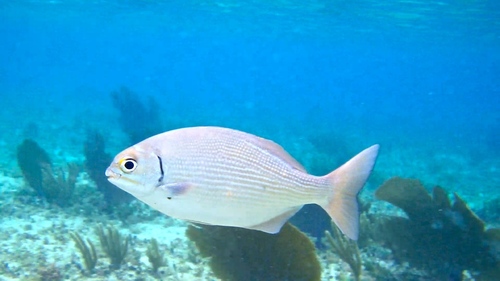
Kyphosus sectatrix has an elliptical body which is almost circular when looked at from the side, with a head that slopes from over the eye to the snout, making the fish appear to be beaked or snouted. It lacks an obvious bulge on its forehead and it has a small, horizontal mouth which opens at the front. There is a regular row of incisorform J-shaped teeth with rounded tips which are set close together in the jaws which have their bases set horizontally creating something like a bony plate with radial striations within the mouth. Ctenoid scales cover most of the body apart from the snout. The dorsal fin is continuous, and has its origin quite far to the rear of the head and longer than the anal fin. The dorsal fin contains 11 spines and 11–12 soft rays while the anal fin has 3 spines and 11 soft rays. The caudal fin is emarginate but not deeply so.

Habitat

Kyphosus sectatrix has a circumglobal distribution and is found in the warmer areas of all the world's oceans. In the eastern Atlantic Ocean it has been recorded from St Helena and Ascension Island the Azores, the Canary Islands, it has been reported from the Algarve in Portugal and there are records from the Mediterranean. In the western Atlantic it is found off Bermuda, in the Sargasso Sea, in the Gulf of Mexico and the Caribbean Sea. It has been recorded from the Trindade Islands of Brazil. It is thought likely that it occurs along the coast of northwest Africa and as far north as Portugal. In the Indian Ocean it has been recorded from Réunion and Indonesia but likely is far more widespread and probably occurs along the eastern African coast into the Red Sea and along the southern Asian coast.

Part of

Where to see it

No dive sites list Bermuda Chub yet. Explore the map to find sites near you.