
← All marine life
Bat Ray
Species IUCN · Least Concern (LC)

Bat Ray

Myliobatis californica, Gill, 1865

marine

About Bat Ray

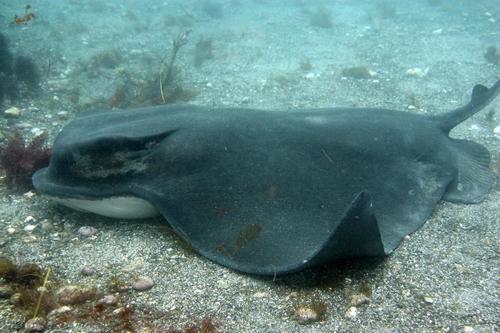
The bat ray (Myliobatis californica) is an eagle ray that has a diamond ray-like form that consists of pectoral fins that are wing-like and end in blunt points. The head is broad and raised higher than the pectoral fins. The eyes are laterally situated on the broad head. Below the front of the head projection is a horizontal depression. This means that instead of the head being flat, there is a slight indent in the top of the head in between the eyes. The tail is whip-like and is typically incomplete with at least one venomous spine at the base of the tail. The incomplete aspect means that the tail consists of cartilage instead of bone. The dorsal side is black or a dark brown while the ventral side is white with the exception of the areas close to the tips or disk.

The largest specimens can grow to a wingspan of 1.8 m (5 ft 11 in) and a mass of 91 kg (201 lb). There is a record of this species reaching 240 pounds, however large specimens are typically closer to 200 pounds. They typically range from 9.07–13.61 kg (20.0–30.0 lb). The size of the bat ray is dependent on many factors, such as habitat alterations and different oceanographic and environmental conditions. Some bat rays are solitary, while others form schools numbering in the thousands.

There has only been one record of albinism in this species during 1865 off the west coast of Baja California, Mexico.

Habitat

The Bat Ray can be found in both tropical and temperate oceans from central Oregon in the USA to Mexico in the Gulf of California. The bat ray (Myliobatis californica) is found in muddy or sandy sloughs, estuaries and bays, kelp beds and rocky-bottomed shoreline. It is also found in the area around the Galápagos Islands. This species can typically be found in flat sections of water with a sand patch in between rocks or with a rocky bottom. They are commonly found in bays and sloughs within the shore area. They can be commonly found around offshore islands including San Clemente, Anacapa, and Santa Rosa. They have been observed during the summer and spring at San Clemente. During March and April they are common in the shallow waters of Santa Rosa. During the summer, they are common in the shallow water around Anacapa Island.
Diet

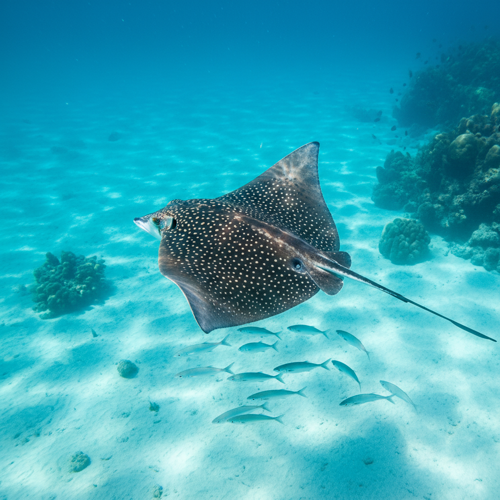
Bat rays feed on mollusks, crustaceans and small fish on the seabed, using their winglike pectoral fins to move sand and expose prey animals. They may also use their snout to dig trenches up to 20 cm deep to expose buried prey, such as clams. Bat rays create pits by excavating the substrate in order to feed upon invertebrates and small fish. These pits can be up to 20 cm deep and 4 m long. By digging up invertebrates, small fish are often attracted to take the chance to opportunistically prey upon these organisms. Bat rays are considered opportunistic generalists which means that they consume the food that is most available to them. These rays are most likely using a type of suction mechanism in order to obtain their smaller prey from the substrate.

Humans & conservation

This species is currently listed as least concern by the IUCN Red List of Endangered Species. Bat rays are not actively regulated according to the Pacific Fishery Management Council. While there are some overarching restrictions on the type of gear that can be used, these rays still have to deal with predators. Predators of the bat ray include California sea lion, great white sharks and broadnose sevengill sharks. To keep themselves safe from predators, bat rays camouflage in the sand.

Part of

Where to see it

No dive sites list Bat Ray yet. Explore the map to find sites near you.