Appearance
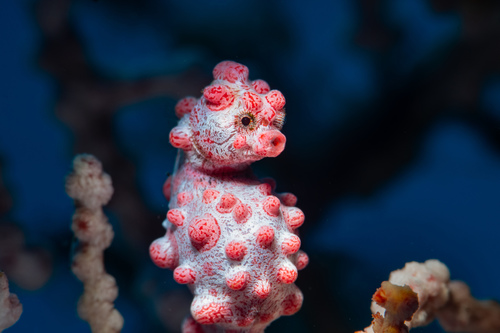
The pygmy seahorse measure less than one inch in length (2 cm), and is naturally well camouflaged and extremely difficult to see amongst the gorgonian coral it lives on. So effective is this camouflage that the species was not formally discovered by researchers until an apparent host coral was being examined in a laboratory; in 1969, a New Caledonian scientist named Georges Bargibant had been collecting specimens of Muricella gorgonians, for the Nouméa museum, when he happened to spot a pair of the tiny seahorses on the coral upon the examination table. The next year, they were officially named by Whitley as "Bargibant's pygmy seahorse". Large, bulbous tubercles (or knobs) cover its body, matching the colors and forms of the polyps of its host species of gorgonian coral, while its body matches the gorgonian stem (to which the seahorse wraps its tail around for stability).