
← All marine life
Banggai Cardinalfish
Species IUCN · Endangered (EN)

Banggai Cardinalfish

Pterapogon kauderni, Koumans, 1933

marine

About Banggai Cardinalfish

The Banggai cardinalfish (Pterapogon kauderni) is a small tropical cardinalfish in the family Apogonidae. It is the only member of its genus, the sailfin cardinalfish which at first was included in Pterapogon now being separated in a distinct genus. This attractive fish is popular in the aquarium trade. It is among the relatively few marine fish to have been bred regularly in captivity, but significant numbers are still captured in the wild and it is now an endangered species. The detrimental impact of humans on its environment and certain fatal diseases threaten this species' numbers significantly. Iridovirus diseases are known to be a significant reason for fish mortality.

Appearance

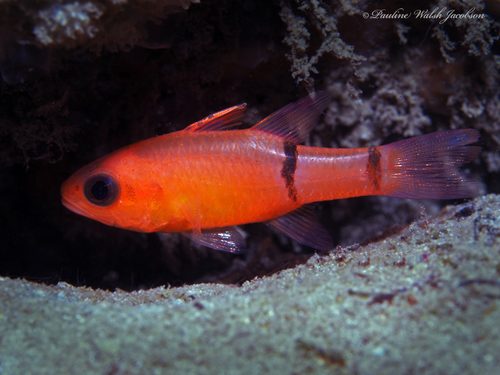
This species grows up to 8 centimetres (3 in) total length. It is easily differentiated from all other cardinalfishes by its tasseled first dorsal fin, elongated anal and second dorsal fin rays, deeply forked caudal fin, and color pattern consisting of three black bars across the head and body and prominent black anterior edges on the anal and second dorsal fin. The male can be differentiated from the female by a conspicuous, enlarged oral cavity, which is apparent only when they are brooding.
Habitat

This species is restricted to the Banggai Islands of Indonesia. This species has an extremely limited geographic range (5,500 km2) and small total population size (estimated at 2.4 million). The Banggai cardinalfish is composed of isolated populations concentrated around the shallows of 17 large and 10 small islands within the Banggai Archipelago. A small population also occurs off Central Sulawesi, within Luwuk harbor. One additional population has become established in the Lembeh Strait (North Sulawesi), 400 km north of the natural area of the species distribution, following introduction by aquarium fish traders in 2000. Small populations seen (May 2014) in Secret Bay, northwest Bali (Banggai cardinal fish, Secret Bay, Bali).

Diet

This fish is an opportunistic feeder. Its diet includes planktonic, demersal, and benthic organisms. Copepods constitute the bulk of its diet. It serves as an important food source for several species of lionfish (Pterois spp.), the honeycomb grouper (Epinephelus merra), the crocodilefish (Cymbacephalus beauforti), the snowflake moray (Echidna nebulosa), the estuarine stonefish (Synanceia horrida), and the yellow-lipped sea krait (Laticauda colubrina).

Behaviour

The Banggai cardinalfish is the only member of its family that is diurnal. It is a demersal tropical marine fish that forms stable groups of about 9 individuals in shallow water, being most common at 1.5 to 2.5 m in depth. It inhabits a variety of shallow habitats, including coral reefs, seagrass beds, and open areas of sand and rubble. It is most common in calm habitats on the protected side of larger islands.

Reproduction

The Banggai cardinalfish is a paternal mouthbrooder. The female plays an active role in courtship and pair formation, which occurs a few hours to a few days before spawning. Mating pairs establish spawning territories several meters away from the main group and vigorously defend them. The eggs are about 2.5 mm in diameter. The young remain in the male's mouth cavity for an undetermined period after hatching. Unlike many other species of marine fish, the Banggai cardinalfish lacks a planktonic stage in its life history. The species has a short lifespan, reaching around 4 years in optimal conditions in captivity, and perhaps 1 to 2 years in the wild.

Part of

Where to see it

No dive sites list Banggai Cardinalfish yet. Explore the map to find sites near you.