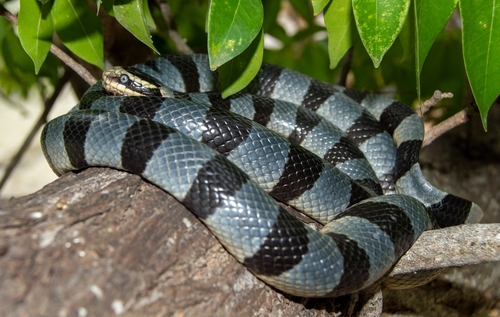
Hunting is often performed alone, but L. colubrina kraits may also do so in large numbers in the company of hunting parties of giant trevally and goatfish. This cooperative hunting technique is similar to that of the moray eel, with the yellow-lipped sea kraits flushing out prey from narrow crevices and holes, and the trevally and goatfish feeding on fleeing prey.
While probing crevices with their heads, yellow-lipped sea kraits are unable to observe approaching predators and can be vulnerable. The snakes can deter predators, such as larger fish, sharks, and birds, by fooling them into thinking that their tail is their head, because the color and movement of the tail is similar to that of the snake's head. For example, the lateral aspect of the tail corresponds to the dorsal view of the head.