
← All marine life
Banded Houndshark
Species IUCN · Endangered (EN)

Banded Houndshark

Triakis scyllium, Müller & Henle, 1839

marinebrackish

About Banded Houndshark

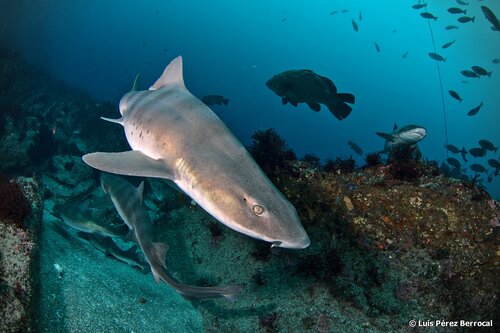
The banded houndshark (Triakis scyllium) is a species of houndshark in the family Triakidae, common in the northwestern Pacific Ocean from the southern Russian Far East to Taiwan. Found on or near the bottom, it favors shallow coastal habitats with sandy or vegetated bottoms, and also enters brackish water. This shark reaches 1.5 m (4.9 ft) in length. It has a short, rounded snout and mostly narrow fins; the pectoral fins are broad and triangular, and the trailing margin of the first dorsal fin is almost vertical. It is gray above and lighter below; younger sharks have darker saddles and dots, which fade with age.

Nocturnal and largely solitary, the banded houndshark preys on benthic invertebrates and bony fishes. It is aplacental viviparous, with the developing embryos sustained by yolk. After mating during summer, females bear as many as 42 pups following a gestation period of 9–12 months. The banded houndshark poses no danger to humans and adapts well to captivity. It is caught as bycatch off Japan, Taiwan, and likely elsewhere in its range; it may be eaten but is not as well-regarded as related species. Because fishing does not appear to have diminished this shark's population, the International Union for Conservation of Nature has listed it under Endangered.

Appearance

The banded houndshark is a moderately slender-bodied species growing up to 1.5 m (4.9 ft) long. The snout is short, broad, and rounded; the widely separated nostrils are each preceded by a lobe of skin that does not reach the mouth. The horizontally oval eyes are placed high on the head; they are equipped with rudimentary nictitating membranes (protective third eyelids) and have prominent ridges underneath. The mouth forms a short, wide arch and bears long furrows at the corners that extend onto both jaws. Each tooth has an upright to oblique knife-like central cusp flanked by strong cusplets. There are five pairs of gill slits.

Habitat

Native to the northwestern Pacific Ocean, the banded houndshark occurs from the southern Russian Far East to Taiwan, including Japan, Korea, and eastern China; records from the Philippines are questionable. This common, benthic shark is found over continental and insular shelves, mostly close to shore, but also to a depth of 150 m (490 ft). It frequents sandy flats and beds of seaweed and eelgrass; additionally, it is tolerant of brackish water and enters estuaries and bays.

Behaviour

The banded houndshark is nocturnal and generally solitary, though several individuals may rest together, sometimes piled atop one another inside a cave. It feeds mainly on crustaceans (including shrimp, crabs, hermit crabs, and mantis shrimp), cephalopods (including octopus), and spoon worms; polychaete worms, tunicates, peanut worms, and small, bottom-living bony fishes (including flatfishes, conger eels, herring, jacks, drums, and grunts) are occasionally consumed. Shrimp and spoon worms are important prey for sharks up to 70 cm (28 in) long; cephalopods predominate in the diets of larger sharks.

Humans & conservation

Harmless to humans, the banded houndshark is commonly displayed in public aquariums in China and Japan, and has reproduced in captivity. Individuals have survived in captivity for over five years. This species is often caught incidentally off Japan in gillnets and set nets; the meat is sometimes sold, but is considered to be of poorer quality than that of other houndsharks in the region. It is caught in lesser numbers off Taiwan, and is probably also fished off Korea and northern China. Off Japan, it can be found in rocky areas that provide refuge from fishing pressure.

Part of

Where to see it

No dive sites list Banded Houndshark yet. Explore the map to find sites near you.