← All marine life
Australian Blacktip Shark
Species IUCN · Least Concern (LC)

Australian Blacktip Shark

Carcharhinus tilstoni, (Whitley, 1950)

marinebrackish

About Australian Blacktip Shark

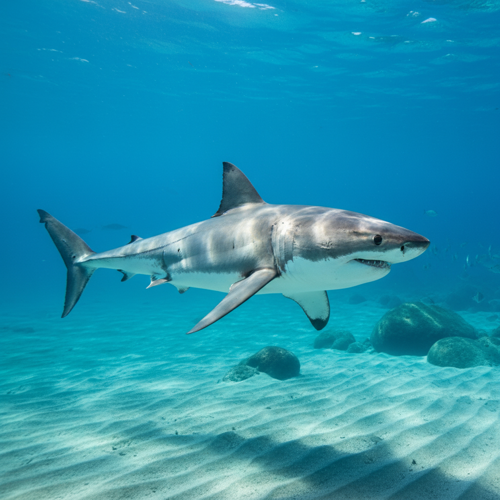
The Australian blacktip shark (Carcharhinus tilstoni) is a species of requiem shark, in the family Carcharhinidae, endemic to northern and eastern Australia. Favoring the upper and middle parts of the water column, it can be found from the intertidal zone to a depth of 50 m (160 ft). Appearance-wise this species is virtually identical to the common blacktip shark (C. limbatus), from which it can be reliably distinguished only by its lower vertebra number and by genetic markers. Generally reaching 1.5–1.8 m (4.9–5.9 ft) in length, it is a fairly stout-bodied, bronze-colored shark with a long snout and black-tipped fins.

Primarily piscivorous, the Australian blacktip shark forms large groups of similar size and sex that tend to remain within a local area. It exhibits viviparity, meaning that the unborn young are provisioned through a placental connection. There is a well-defined annual reproductive cycle with mating occurring in February and March. Females bear one to six pups around January of the following year, after a 10-month gestation period. The Australian blacktip shark is among the sharks most commonly caught by northern Australian commercial fisheries. It is mainly valued for its meat, which is sold as "flake". This species was an important catch of a Taiwanese gillnet fishery that operated from 1974 to 1986, and of the Australian Northern Shark Fishery that continues to the present day. As current fishing levels are not thought to threaten this shark's population, the International Union for Conservation of Nature (IUCN) has assessed it as Least Concern.

Appearance

Physically, the Australian blacktip shark can only reliably be distinguished from the common blacktip shark by the number of vertebrae (174–182 total, 84–91 before the tail in C. tilstoni, 182–203 total, 94–102 before the tail in C. limbatus). It has a moderately robust, spindle-shaped body and a long, pointed snout. The anterior rims of the nostrils are slightly enlarged into low triangular flaps. The large, circular eyes are equipped with nictitating membranes. The furrows at the corners of the mouth are barely evident. There are 32–35 upper and 29–31 lower tooth rows; each upper tooth has a slender, upright cusp and fine serrations that become coarser near the base, while the lower teeth are narrower and more finely serrated. The five pairs of gill slits are long.

Habitat

Inhabiting the continental shelf, the Australian blacktip shark is found from Thevenard Island in Western Australia to Sydney in New South Wales. Within its range, it co-occurs with the common blacktip shark; the ratio between C. limbatus and C. tilstoni was once thought to be 1:300, but recent genetic studies have found it to be closer to 50:50. This species has been reported from the intertidal zone to a depth of 150 m (490 ft); larger sharks tend to occur in deeper water. Though it occupies the entire water column, it is most common close to the surface or in midwater. Genetic data suggest Australian blacktip sharks across northern Australia are all members of a single population. Tagging studies have found this species mostly moves only short distances along the coastline and rarely enters offshore waters.

Behaviour

The Australian blacktip shark is known to form large groups, segregated by size and sex. It preys mainly on teleost fishes, including ponyfishes, grunters, tunas, and herring. Cephalopods are a secondary food source, which are particularly important around April. This species also occasionally consumes smaller sharks, including snaggletooth sharks (Hemipristis pristis), spottail sharks (C. sorrah), and sharpnose sharks (Rhizoprionodon). Their diets shift with age: smaller individuals feed on proportionately more bottom-dwelling fish, while larger individuals feed on proportionately more midwater fish and cephalopods. Documented parasites of this shark include the tapeworms Fossobothrium perplexum and Platybothrium sp., and the copepod Perissopus dentatus.

Humans & conservation

Along with the spottail shark, the Australian blacktip shark is one of the most economically important sharks off northern Australia. It was historically fished for its meat and fins by a Taiwanese gillnet fishery, which began operating off northern Australia in 1974. The annual catch initially averaged around 25,000 tons (live weight), with approximately 70% consisting of Australian blacktip sharks, spottail sharks, and longtail tuna (Thunnus tonggol). Following the establishment of the Australian Fishing Zone (AFZ) in November 1979, the Australian government progressively excluded Taiwanese gillnet vessels from large portions of Australian waters and imposed fishing quotas. The fishery eventually became uneconomical when Australia restricted gillnet lengths to 2.5 km (1.6 mi) in May 1986, and Taiwanese vessels ceased fishing in Australian waters that year.

Part of

Where to see it

No dive sites list Australian Blacktip Shark yet. Explore the map to find sites near you.