
← All marine life
Atlantic Wolffish
Species

Atlantic Wolffish

Anarhichas lupus, Linnaeus, 1758

marine

About Atlantic Wolffish

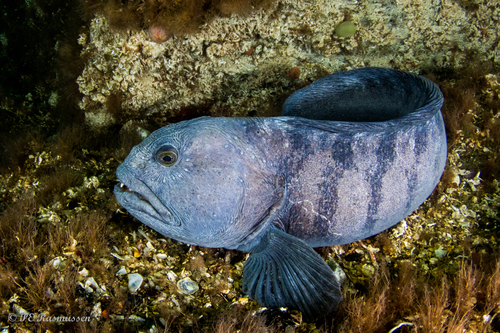
The Atlantic wolffish (Anarhichas lupus), also known as the seawolf, Atlantic catfish, ocean catfish, devil fish, wolf eel (the common name for its Pacific relative), woof or sea cat, is a marine fish of the wolffish family Anarhichadidae, native to the North Atlantic Ocean. The numbers of the Atlantic wolffish in US waters are rapidly being depleted, most likely due to overfishing and bycatch, and it is currently a Species of Concern according to the U.S. National Oceanic and Atmospheric Administration's National Marine Fisheries Service.

Apart from their unique appearance, wolffish are distinguished by the natural antifreeze they produce to keep their blood moving fluidly in their very cold habitat, involvement by both the male and female in brood bearing and the large size of their eggs. They are also an important factor in controlling green crab and sea urchin populations, which can become overly disruptive to habitats if left unchecked. Wolffish population success is also an important indicator of the health of other bottom-dweller populations, such as Atlantic cod.

Appearance

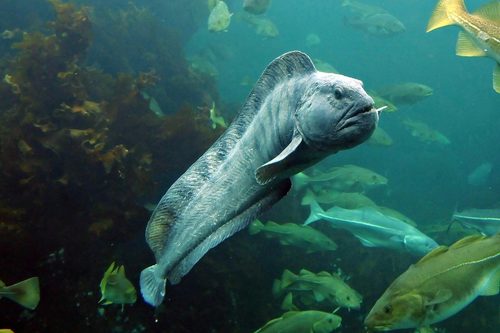
The Atlantic wolffish has retained the bodily form and general external characteristics of small blennies (Blennioidei). The largest specimen recorded measured 1.5 m (5 ft) long and weighed almost 18 kg (40 lb). Its body is long, subcylindrical in front, compressed in the caudal portion, smooth and slippery, the rudimentary scales being embedded and almost hidden in the skin. Atlantic wolffish vary in color, usually seen as purplish-brown, a dull olive green, or blueish gray. An even dorsal fin extends the whole length of the back, and a similar fin from the vent to the caudal fin, as in blennies. The pectorals are large and rounded and the pelvic fins are entirely absent. Its obtuse, eel-like body type makes the fish swim slowly, undulating from side to side, like an eel.
Diet

Atlantic wolffish use their strong jaws to eat hardshell molluscs, crustaceans, and echinoderms. They do not eat other fish. They are known to frequently eat large whelks (Buccinum), cockles (Polynices, Chrysodomus and Sipho), sea clams (Mactra), large hermit crabs, starfish, and sea urchins. They are an important predator of sea urchins and green crabs, whose populations escalate rapidly and can negatively affect the health of a marine system.

Reproduction

The manner in which Atlantic wolffish fertilize their eggs distinguishes them from many fish. Instead of the female depositing her eggs in the open ocean for the male fish to fertilize and then continue on his way, they are internally fertilized and the male wolffish stays with the nest and protects the eggs for as long as four months, until the brood is strong enough to gain independence. Their eggs are 5.5–6.0 mm in diameter, (among the largest fish eggs known), yellow tinted and opaque. The eggs are laid on the ocean floor, often in shoal water, sticking together in loose clumps, surrounded by seaweeds and stones. Atlantic wolffish mature relatively late, at age six.

Humans & conservation

According to data compiled by the National Marine Fisheries Service, since 1983, the landings from U.S. fishing vessels of Atlantic wolffish as bycatch has declined 95%, landing 64.7 t (63.7 long tons; 71.3 short tons) in 2007. In 1950, when the NMFS started collecting their data, 1,098 t (1,081 long tons; 1,210 short tons) of Atlantic wolffish were landed, worth $137,008. In 1970, 271.2 t (266.9 long tons; 298.9 short tons); the landings peaked in 1983 at 1,207 t (1,188 long tons; 1,330 short tons), bringing in $455,291; rapidly depleting again and by 1990 the landings were down to 400 t (390 long tons; 440 short tons), and by 2002, 154 t (152 long tons; 170 short tons). The last available data from the NMFS were in 2007 at 64.7 t (63.7 long tons; 71.3 short tons), worth a total of $100,341.

Part of

Where to see it

No dive sites list Atlantic Wolffish yet. Explore the map to find sites near you.