
← All marine life
Atlantic White-Spotted Octopus
Species IUCN · Least Concern (LC)

Atlantic White-Spotted Octopus

Pinnoctopus macropus, (Risso, 1826)

marine

About Atlantic White-Spotted Octopus

Pinnoctopus macropus, also known as the Atlantic white-spotted octopus, white-spotted octopus, grass octopus or grass scuttle, is a species of octopus found in shallow areas of the Mediterranean Sea, the warmer parts of the eastern and western Atlantic Ocean, the Caribbean Sea, and the Indo-Pacific region. This octopus feeds on small organisms which lurk among the branches of corals.

Appearance

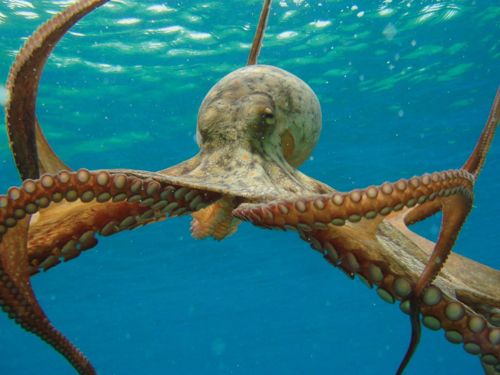
Pinnoctopus macropus grows to a mantle length of 20 cm (8 in) with a total length of 150 cm (59 in). The first pair of arms are a metre or so long, and are much longer than the remaining three pairs. The arms are all connected by a shallow web. This octopus is red, with white blotches on its body, and paired white spots on its arms. When it is disturbed, its colour becomes more intense, deimatic behaviour which may make it appear threatening to a potential predator.
Habitat

Populations of Pinnoctopus macropus form a species complex found in the Mediterranean Sea, the temperate and tropical Atlantic Ocean and the Caribbean Sea. It is also present in the Pacific and Indian Oceans. It lives near the shore at depths down to about 17 m (56 ft). Its favoured habitat is sand, rubble or seagrass meadows, and it sometimes buries itself under the sand.

Behaviour

Pinnoctopus macropus is more fastidious in its diet than is the common octopus (Octopus vulgaris), a species with which it shares some of its range and which feeds by day. Pinnoctopus macropus, by contrast, feeds by night. Its method of feeding is to move from one clump of branching coral to another, often Acropora or Stylophora spp.. The octopus wraps its mantle around a coral head and probes with its arms among the branches, searching for the small fish and invertebrates that seek protection there. It has been found that a number of groupers (family Serranidae) and other predatory fish associate with the octopus when it is feeding, pouncing on small organisms that are flushed from the coral head by the octopus.

Part of

Where to see it

No dive sites list Atlantic White-Spotted Octopus yet. Explore the map to find sites near you.