← All marine life
Atlantic Torpedo
Species IUCN · Least Concern (LC)

Atlantic Torpedo

Tetronarce nobiliana, (Bonaparte, 1835)

marine

About Atlantic Torpedo

The Atlantic torpedo (Tetronarce nobiliana) is a species of electric ray in the family Torpedinidae. It is found in the Atlantic Ocean, from Nova Scotia to Brazil in the west and from Scotland to West Africa and off southern Africa in the east, occurring at depths of up to 800 m (2,600 ft), and in the Mediterranean Sea. Younger individuals generally inhabit shallower, sandy or muddy habitats, whereas adults are more pelagic in nature and frequent open water.

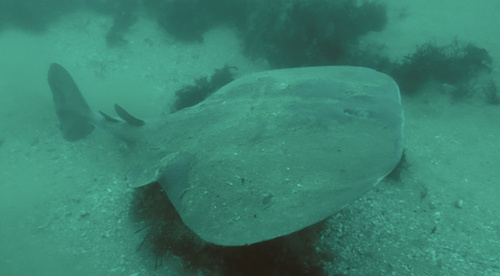
Weighing up to 90 kg (200 lb), with a length of 1.8 m (6 ft), the Atlantic torpedo is the largest known electric ray. Like other members of its genus, it has an almost circular pectoral fin disk with a nearly straight leading margin, and a robust tail with a large triangular caudal fin. Distinctive characteristics include its uniform dark color, smooth-rimmed spiracles (paired respiratory openings behind the eyes), and two dorsal fins of unequal size. Its diet consists mainly of bony fish, though it also feeds on small sharks and crustaceans.

An aplacental viviparous species, females give live birth to up to 60 young following a gestation period of one year. During gestation, the developing embryos are nourished by yolk and then by maternally produced histotroph ("uterine milk").

Solitary and nocturnal, the Atlantic torpedo is capable of generating up to 220 volts of electricity to subdue its prey or defend itself against predators. For a humans, this electric shock is severe and painful, although usually not fatal.

Appearance

The Atlantic torpedo has a nearly circular pectoral fin disc 1.2 times as wide as it is long, with a thick and nearly straight front margin. The eyes are small and are followed by much larger spiracles, which do not have papillae on their inner rims. The nostrils are close to the mouth; there is a flap of skin between them three times as wide as long, with a sinuous rear margin. The mouth is wide and arched, with prominent furrows at the corners. The teeth are pointed and increase in number with age, ranging from 38 rows in juveniles to 66 rows in adults; the first several series of teeth are functional. The gill slits are small, with the first and fifth pairs shorter than the others.

Habitat

The Atlantic torpedo is widely distributed in cool waters on both sides of the Atlantic Ocean. In the east, it is found from northern Scotland to the Gulf of Guinea, including the entire Mediterranean Sea (but not the Black Sea), the Azores, and Madeira, as well as from Namibia to western South Africa. In the west, it occurs from southern Nova Scotia to Venezuela and Brazil. It is rare in the North Sea and the Mediterranean and south of North Carolina. The genus Tetronarce is represented by a single species in the Mediterranean Sea, easy to identify with its characteristic dark blue pattern.

Diet

The diet of the Atlantic torpedo consists mainly of bony fishes, including flatfishes, salmon, eels, and mullet, though it has also been known to take small catsharks and crustaceans. Captive rays have been observed lying still on the bottom and "pouncing" on fish that pass in front of them. At the moment of contact, the ray traps the prey against its body or the bottom by curling its pectoral fin disc around it, while delivering strong electric shocks. This strategy allows the sluggish ray to capture relatively fast-moving fish. Once subdued, the prey is maneuvered to the mouth with rippling motions of the disc and swallowed whole, head-first.

Behaviour

Like other members of its family, the Atlantic torpedo is capable of generating a powerful electric shock from a pair of kidney-shaped electric organs in its disc, for both attack and defense. These organs comprise one-sixth of the ray's total weight and contain around half a million jelly-filled "electric plates" arranged in an average of 1,025–1,083 vertical hexagonal columns (visible beneath the skin). These columns essentially act as batteries connected in series, enabling a large Atlantic torpedo to produce up to a kilowatt of electricity at 170–220 volts, provided that it is well-fed and rested. The discharges from the electric organ occur in a series, or train, of closely spaced pulses each lasting around 0.03 seconds. Trains contain on average 12 pulses, but trains of over 100 pulses have been recorded. The ray regularly emits pulses even without an obvious external stimulus.

Humans & conservation

Though seldom life-threatening, the electric discharge of an Atlantic torpedo is quite severe and may be enough to knock a person unconscious. However, a greater danger to divers is the disorientation that follows the shock. The Atlantic torpedo is of no commercial value, as its meat is flabby and tasteless. It is caught incidentally by commercial and recreational fisheries in bottom trawls and on hook-and-line. When caught at sea, it is generally discarded or cut up for bait. The International Union for Conservation of Nature (IUCN) assesses the Atlantic torpedo as Least Concern; it could be negatively affected by fishing mortality, though specific data on catch rates and population trends are lacking, as well as by the degradation of coral reefs that are important to juveniles. Its slow reproductive rate would limit its capacity to recover from population depletion.

Part of

Where to see it

No dive sites list Atlantic Torpedo yet. Explore the map to find sites near you.