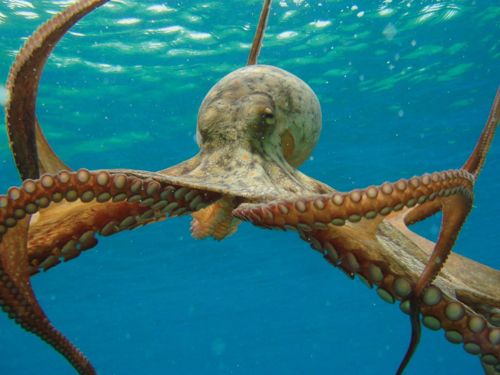
Appearance
O. joubini is red-orange in color which is caused by pigmented cells called chromatophores that are common in many animals. Compared to other species of octopus, the O. joubini color patterning is relatively less complex. They are capable of becoming a dark, light, or intermediate shade ranging from brown to orange. As hatchlings, their chromatophores can also appear yellow.
Though research is limited, some studies suggest that O. joubini have a complex system of sensory cells along their lip that serve a chemotactic function. These cells are highly ciliated and contain high concentrations of sensory neurons, some of which are thought to act as mechanoreceptors, and some as chemoreceptors. These neurons are likely chemoreceptors, considering the species' benthic lifestyle and the advantages that come with chemotactic sensitivity.