
← All marine life
Atlantic Mackerel
Species IUCN · Least Concern (LC)

Atlantic Mackerel

Scomber scombrus, Linnaeus, 1758

marinebrackish

About Atlantic Mackerel

The Atlantic mackerel (Scomber scombrus), also known as Boston mackerel, Norwegian mackerel, Scottish mackerel or just mackerel, is a species of mackerel found in the temperate waters of the Mediterranean Sea, the Black Sea, and the northern Atlantic Ocean, where it is extremely common and occurs in huge shoals in the epipelagic zone down to about 200 m (660 ft). It spends the warmer months close to shore and near the ocean surface, appearing along the coast in spring and departing with the arrival of colder weather in the fall and winter months. During the fall and winter, it migrates out into deeper and more southern water, seeking warmer temperatures.

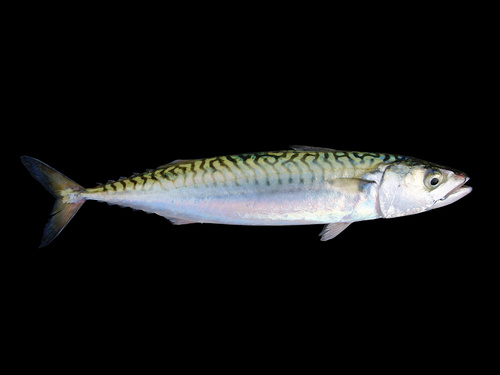
The Atlantic mackerel's body is elongate, steel-blue marked with wavy black lines dorsally and silvery-white ventrally, its snout long and pointed. It possesses two spiny dorsal fins, which are spaced far apart, two pectoral fins, and small caudal and anal fins, also spaced far apart. 4–6 dorsal finlets and 5 anal finlets are typical among members of this species. The fish's body tapers down its length, ending with a large tail fin. Typical size for a mature fish is 30 cm (0.98 ft), but individuals have been caught as large as 60 cm (2.0 ft). The maximum published weight is 3.4 kg (7.5 lb). Reproduction, which is oviparous, occurs near the shore in the spring and summer, during which a female can produce as many as 450,000 eggs. Juveniles reach sexual maturity at around 2 years of age and can live to be 17.

Appearance

The Atlantic mackerel has an elongate, fusiform body with a long, pointed snout. The eyes are large and covered by an adipose eyelid, while the teeth are small, sharp, and conical. Scales are also small, with the exceptions of those immediately posterior to the head and around the pectoral fins. These small scales give the Atlantic mackerel a velvet-like feel. The two dorsal fins are large and spaced far apart. The second dorsal fin is typically followed by 5 dorsal finlets, though it can have 4 or 6. The anal fin, which originates slightly behind the second dorsal fin, is similar to it in size and shape and is also succeeded by 5 finlets. The fish's body tapers to a slim caudal peduncle, the end of the fish to which the short but broad tail fin is attached. Its body is steel-blue dorsally with wavy black lines running perpendicular to the fish's length.
Habitat

The Atlantic mackerel's native range in the western Atlantic extends from Labrador, Canada to Cape Lookout, North Carolina. In the eastern Atlantic, it can be found from Iceland and Norway to as far south as Mauritania. It is also found in the Mediterranean, Black, and Baltic Seas. Its latitudinal range is 70°N-25°N and its longitudinal range is 77°W-42°E. Its preferred water temperature is above 8 °C (46 °F), but Atlantic mackerel are common in waters as cold as 7 °C (45 °F) and have been found, albeit rarely, in 4.5 °C (40.1 °F) waters. The Atlantic mackerel's common depth range extends from the surface to 200 m (660 ft), but individuals can be found as deep as 1,000 m (3,300 ft).

Diet

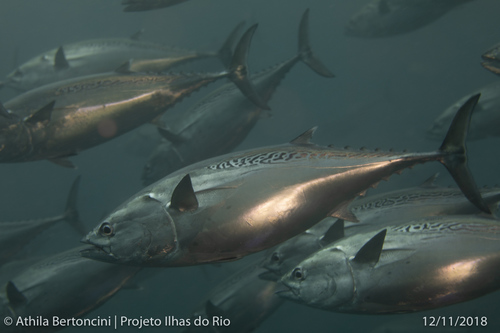
When feeding on larger prey, schools tend to break down into shoals and individuals find food on their own. When consuming plankton, however, Atlantic mackerel form tight aggregations, open their mouths as wide as possible, and extend their operculums, swimming in a tightly packed school that acts like a series of miniature tow nets. Spaced only about the diameter of a single fish's mouth apart, this formation greatly reduces the ability of plankton to evade capture, as a plankton darting out of the way of one fish is likely to end up in the jaws of another. Copepods make up the majority of the Atlantic mackerel's diet, Calanus finmarchicus being the most abundant.

Behaviour

The Atlantic mackerel is an active, fast-moving fish that must keep in constant motion to bring in enough oxygen to survive. It swims using short movements of the rear of its body and the caudal fin. Unlike other mackerel, Atlantic mackerel do not leap out of the water unless attempting to escape a predator. They form large schools, consisting of individuals of the same relative size, near the ocean surface during all seasons but winter. Because larger fish have a greater ratio of muscle mass to surface area, schools of larger fish are able to swim more quickly than schools made up of smaller individuals.

Humans & conservation

The Atlantic mackerel is of commercial importance to many Atlantic fisheries, which catch it with purse seines, trawls, gill and trammel nets, and trolling lines. Global annual catch is typically in the range of 1 million tonnes, though a 50% spike in 2014 put this number at nearly 1.5 million tonnes. The United Kingdom and Norway bring in the most Atlantic mackerel, with annual catches coming in at over 166,000 tonnes and 160,000 tonnes respectively. In 2022 alone, Norwegian fisheries exported an estimated 6.3 billion Norwegian Kroner worth of the Atlantic mackerel. The majority of the mackerel caught by Norwegian fisheries is exported to countries including China, Japan, South Korea, and Vietnam. There are three stocks in the eastern Atlantic: one in the south, one in the west, and another in the North Sea.

Part of

Where to see it

No dive sites list Atlantic Mackerel yet. Explore the map to find sites near you.