
← All marine life
Atlantic Longarm Octopus
Species IUCN · Least Concern (LC)

Atlantic Longarm Octopus

Macrotritopus defilippi, (Vérany, 1851)

marine

About Atlantic Longarm Octopus

Macrotritopus defilippi, commonly known as the Lilliput longarm octopus or the Atlantic longarm octopus, is a small species of octopus, a marine cephalopod mollusc of the order Octopoda.

This species occurs in the Atlantic Ocean, the Mediterranean Sea and the Indian Ocean. Its typical habitat is shallow sandy areas. Its yellowish-brown colouration enables it to blend into its surroundings making it well-camouflaged when stationary. In the Caribbean it has been found that when it moves around, it does so in such a way as to closely resemble the swimming behaviour of the plate fish (Bothus lunatus), a bottom-dwelling flounder which inhabits the same waters.

Appearance

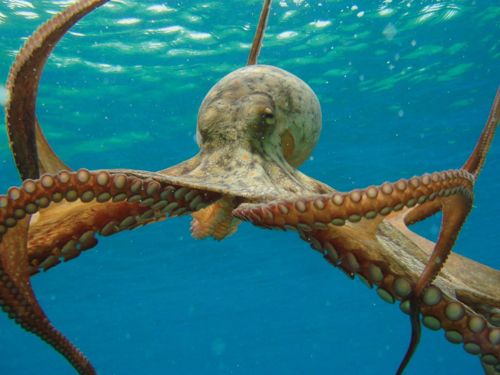
Macrotritopus defilippi is a small octopus with relatively long arms and a mantle length of up to 90 mm (3.5 in). As is the case in most octopuses, the skin is variable in colour. It is usually either plain or speckled and closely matches the colour of its surroundings, the sandy plains on which it lives. Where the substrate includes gravel among the sand, the mottled pattern is often larger, there can be small papillae (fleshy protuberances) on the skin, and some light and dark barring on the arms. In some circumstances a white leucophore has been observed on the mantle tip; this may provide a disruptive camouflage when there are white pebbles in the vicinity.
Habitat

Macrotritopus defilippi has been reported from the Atlantic Ocean, including the Caribbean Sea, the Mediterranean Sea, the northern Indian Ocean and the coast of Somalia.

Behaviour

Macrotritopus defilippi is well camouflaged on a sandy seabed, but it is a predator and needs to move around in order to feed. When it does this, its camouflage breaks down. Humann and DeLoach (2002) reported that Macrotritopus defilippi sometimes swam backwards in a normal octopus-style but that on other occasions, it moved forwards in a flattened position with its arms streaming beside it, making it superficially resemble a flatfish. The octopus swims close to the contours of the sand surface, even hugging ripples in the sand, so that no shadows are formed. Macrotritopus defilippi has a unique skin microbiome that helps protect it from harmful bacteria in its environment. Studies have shown that its skin harbors specific bacterial communities, including members of the Flavobacteriaceae family.

Part of

Where to see it

No dive sites list Atlantic Longarm Octopus yet. Explore the map to find sites near you.