
← All marine life
Atlantic Cod
Species IUCN · Vulnerable (VU)

Atlantic Cod

Gadus morhua, Linnaeus, 1758

marinebrackish

About Atlantic Cod

The Atlantic cod (pl.: cod; Gadus morhua) is a fish of the family Gadidae, widely consumed by humans. It is also commercially known as cod or codling.

In the western Atlantic Ocean, cod has a distribution north of Cape Hatteras, North Carolina, and around both coasts of Greenland and the Labrador Sea; in the eastern Atlantic, it is found from the Bay of Biscay north to the Arctic Ocean, including the Baltic Sea, the North Sea, Sea of the Hebrides, areas around Iceland and the Barents Sea.

Atlantic cod can live for up to 25 years and typically grow up to 100–140 cm (40–55 in), but individuals in excess of 180 cm (70 in) and 50 kg (110 lb) have been caught. They will attain sexual maturity between ages 2 and 8, but this varies between populations and has varied over time.

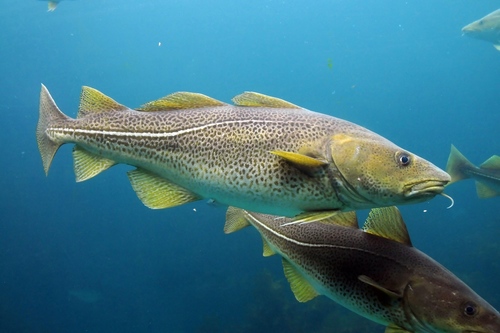
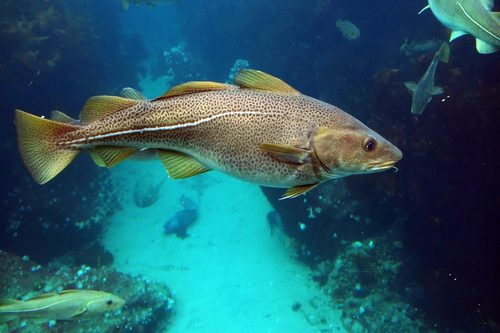
Colouring is brown or green, with spots on the dorsal side, shading to silver ventrally. A stripe along its lateral line (used to detect vibrations) is visible. Its habitat ranges from the coastal shoreline down to 300 m (1,000 ft) along the continental shelf.

Atlantic cod is one of the most heavily fished species. Atlantic cod was fished for a thousand years by north European fishers who followed it across the North Atlantic Ocean to North America. It supported the US and Canadian fishing economy until 1992, when the Canadian Government implemented a ban on fishing cod.

Diet

Atlantic cod are apex predators in the Baltic and adults are generally free from the concerns of predation. Juvenile cod, however, may serve as prey for adult cod, which sometimes practice cannibalism. Juvenile cod make substrate decisions based on risk of predation. Substrates refer to different feeding and swimming environments. Without apparent risk of predation, juvenile cod demonstrated a preference for finer-grained substrates such as sand and gravel-pebble. However, in the presence of a predator, they preferred to seek safety in the space available between stones of a cobble substrate. Selection of cobble significantly reduces the risk of predation. Without access to cobble, the juvenile cod simply tries to escape a predator by fleeing.
Behaviour

Atlantic cod are a shoaling species and move in large, size-structured aggregations. Larger fish act as scouts and lead the shoal's direction, particularly during post spawning migrations inshore for feeding. Cod actively feed during migration and changes in shoal structure occur when food is encountered. Shoals are generally thought to be relatively leaderless, with all fish having equal status and an equal distribution of resources and benefits. However, some studies suggest that leading fish gain certain feeding benefits. One study of a migrating Atlantic cod shoal showed significant variability in feeding habits based on size and position in the shoal. Larger scouts consumed a more variable, higher quantity of food, while trailing fish had less variable diets and consumed less food.

Reproduction

Atlantic cod will attain sexual maturity between ages 2 and 8, but this varies between different populations and has also varied over time with a population. Their gonads take several months to develop and most populations will spawn from January to May. Many populations have spawning grounds distinct from their feeding grounds, requiring the fish to migrate to spawn. On the spawning area, males and females will form large schools. Based on behavioral observations of cod, the cod mating system has been likened to a lekking system, which is characterized by males aggregating and establishing dominance hierarchies, at which point females may visit and choose a spawning partner based on status and sexual characteristics. Evidence suggests male sound production and other sexually selected characteristics allow female cod to actively choose a spawning partner.

Humans & conservation

Atlantic cod has been targeted by humans for food for thousands of years, and with the advent of modern fishing technology in the 1950s there was a rapid rise in landings. Cod is caught using a variety of fishing gears including bottom trawls, demersal longlines, Danish seine, jigging and hand lines. The quantity of cod landed from fisheries has been recorded by many countries from around the 1950s and attempts have been made to reconstruct historical catches going back hundreds of years. ICES and NAFO collects landings data, alongside other data, which is used to assess the status of the population against management objectives. Eastern Atlantic landings frequently exceed 1 million tonnes annually from across 16 populations/management units with landings from the Northeast Atlantic cod population and Iceland accounting for the majority of the landings.

Part of

Where to see it

No dive sites list Atlantic Cod yet. Explore the map to find sites near you.