
← All marine life
Asian Sheepshead Wrasse
Species IUCN · Data Deficient (DD)

Asian Sheepshead Wrasse

Semicossyphus reticulatus, (Valenciennes, 1839)

marine

About Asian Sheepshead Wrasse

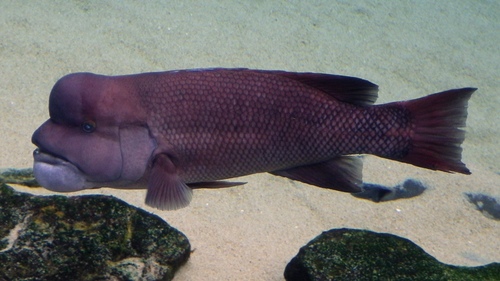
The Asian sheephead wrasse (Bodianus reticulatus), also known as kobudai (瘤鯛 or コブダイ) in Japan, is one of the largest species of wrasse. Native to the western Pacific Ocean, it inhabits rocky reef areas and prefers temperate waters around the Korean Peninsula, China and Japan (including the Ogasawara Islands). It can reach 100 cm (39 in) in total length, and the greatest weight recorded is 14.7 kg (32 lb).

Appearance

The Asian sheephead wrasse is one of the largest wrasses found in the waters of the western Pacific, reaching a weight of around 14.7 kg (32 lb) and a length of 100 cm (39 in). The body is globiform and bulky, the caudal fin is truncate, and males are typically larger than females. The mouth is terminal, consistent with the fact that this fish is usually present in the middle of the water column, and prefer to eat prey directly in front of or beneath it. This fish has hard tooth-like structures present in the mouth, which are excellent for crushing crustaceans.
Diet

The Asian sheephead wrasse mostly consumes marine invertebrates such as mollusks, crabs, and sea urchins, but also takes vertebrates like small fish. In eating sea urchins, the Asian sheephead wrasse plays an important role in their population control, and thus is crucial in maintaining healthy marine habitats.

Humans & conservation

The sheephead wrasse gained media attention when the sex change was caught on camera by the BBC Earth crew while filming in the waters near Sado Island, Japan. In 2017, it was shown on the Blue Planet II episode "One Ocean".

According to Great Big Story, Japanese diver Hiroyuki Arakawa had a 30-year relationship with an Asian sheephead wrasse, which he named "Yuriko", in Japan's Tateyama Bay, where he was the caretaker for an underwater Shinto shrine. He would call Yuriko by hitting a bell on the underwater shrine.

In Japan, this species is considered edible, and it is valued for its sweet, shellfish-like taste.

Part of

Where to see it

No dive sites list Asian Sheepshead Wrasse yet. Explore the map to find sites near you.