
← All marine life
Asian Green Mussel
Species

Asian Green Mussel

Perna viridis, (Linnaeus, 1758)

marine

About Asian Green Mussel

Perna viridis, known as the Asian green mussel, is an economically important species of mussel, a bivalve belonging to the family Mytilidae, or the "true mussels". It is harvested for food, but can harbor toxins and cause damage to submerged structures such as drainage pipes. It is native to the Asia-Pacific region, but has been introduced in the Caribbean, and in the waters around Japan, North America, and South America.

Appearance

Perna viridis ranges from 80 to 100 millimetres (3 to 4 in) in length and may occasionally reach 165 millimetres (6 in). Its shell ends in a downward-pointing beak. The smooth periostracum is dark green, becoming increasingly brownish towards its point of attachment (umbo), where it is lighter. Younger mussels are bright green and that becomes darker as it ages. The shell's interior has a pale-blue sheen.

The mussel has a large mobile foot which it uses to climb vertically, should it be covered by sediments. It also produces byssus to help it attach to its substrate.

Perna canaliculus and Perna perna are two similar species, native to the waters of New Zealand and Africa respectively.
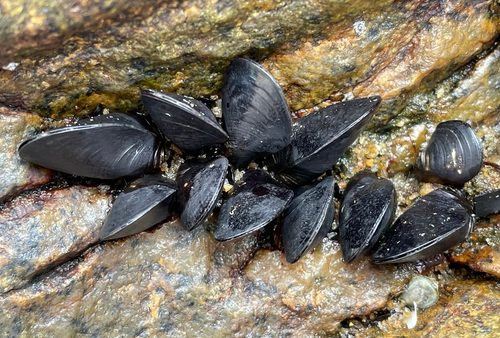
Habitat

The Asian green mussel is found in the coastal waters of the Indo-Pacific region. However the mussels are introduced to other areas as an invasive species via boat hulls and water ballasts.

The mussel inhabits estuarine habitats and is found in densities as high as 35,000 individuals per square meter on any submerged marine object. Although vivid green in appearance, the mussels are shrouded with overgrowth and are often hard to find. The mussels live in waters that are 11–32 °C (52–90 °F) with a wide-ranging salinity of about 18-33 ppt. P. viridis grows fastest at 2 metres (2 yards) below the surface, in high salinity and a high concentration of phytoplankton, although it can tolerate a range of salinity and turbid water.

Behaviour

The Asian green mussel has separate sexes and fertilizes externally. There are a very few functional hermaphrodites (<0.1%). The mussel's sexual development was shown to be affected by temperature. Spawning ordinarily occurs twice a year between early spring and late autumn; however, the mussels found in the Philippines and Thailand are known to spawn all year round.

Humans & conservation

P. viridis is harvested in the Indo-Pacific region as a food source due to its fast growth. However, it can harbor deadly saxitoxins produced by the dinoflagellates that it feeds upon. It can also be used as a biomonitor to indicate pollution caused by heavy metals, organochlorides and petroleum products. Mussels that are in contaminated areas have labile lysosomal membranes due to metal-induced stress.

Part of

Where to see it

No dive sites list Asian Green Mussel yet. Explore the map to find sites near you.