
← All marine life
Arctic Cod
Species

Arctic Cod

Boreogadus saida, (Lepechin, 1774)

marinebrackish

About Arctic Cod

Boreogadus saida, known as the polar cod or as the Arctic cod, is a fish of the cod family Gadidae, related to the true cod (genus Gadus). Another fish species for which both the common names Arctic cod and polar cod are used is Arctogadus glacialis.

Appearance

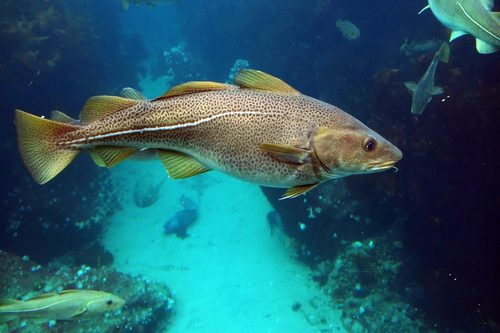
Arctic cod have slender bodies, deeply forked tails, a projecting mouth, and a small chin barbel. They have three dorsal fins and two anal fins, which are all separate from each other. The caudal fin is concave, the pectoral fins reach beyond the end of the first dorsal fin, and the pelvic fins are elongated rays. The lateral line is interrupted along the entire length of the fish.

They are plainly coloured with brownish spots and a silvery body. Greenlandic Inuit fishers have described two morphotypes of Arctic cod, a lighter-colored variety and a darker-colored variety.

Arctic cod are frequently misidentified as polar cod (Arctogadus glacialis) during their larval and early juvenile stages. The species can be differentiated through the analysis of otoliths or molecular data.

Arctic cod grow to an average length of 25 cm (9.8 in), and a maximum length of 40 cm (16 in).
Habitat

This species is found further north than any other fish (beyond 84°N) with a circumpolar distribution spanning the entire North Polar Basin above Russia, Alaska, Canada, and Greenland. More specifically, in the Arctic Ocean, Bering Sea, Chukchi Sea, Beaufort Sea, Hudson Bay, Baffin Bay, Greenland Sea, Barents Sea, Kara Sea, Laptev Sea and the Eastern Siberian Sea. Arctic cod occur in almost all Arctic and Subarctic marine habitats, ranging from coastal waters, the mesopelagic zone, the deeper central Arctic Ocean, and under ice. Arctic cod are the most abundant demersal Arctic species in the Beaufort Sea.

Arctic cod exhibit diel vertical migration patterns during winter and spring, but migration is not observed during summer.

Diet

Arctic cod are generalists that feed on plankton and krill, more specifically hyperiid amphipods, gammarid amphipods, and copepods. Diet varies based on size, region, and locality. Arctic cod larvae feed on eggs, nauplii, and copepods. Larger Arctic cod engage in piscivory. When their preferred prey is scarce, Arctic cod are adaptable and will switch to any other available prey.

Because Arctic winters have low primary production rates, Arctic cod accumulate energy reserves rapidly during the late summer to prepare for the overwintering period. To withstand short summer growing seasons, Arctic cod juveniles enter winter with higher lipid concentrations compared to boreal species.

Reproduction

Arctic cod have multiple reproductive cycles throughout their lives. Arctic cod are an r-selected species, meaning they reach maturity early and produce high numbers of offspring. On average, a female will lay between 9,000 and 21,000 eggs. Spawning occurs between September and April, and peaks between January and February. Spawning locations are not fully known, but spawning is suggested to occur in the Barents Sea to the southwest of the Svalbard Island chain, and the Kara and Pechora seas. In the Canadian Arctic, spawning is suggested to occur near the Franklin and Darney bays. In the Pacific Arctic, spawning is suggested to occur in the northern Bering Sea, Chukchi Sea, and Kotzebue Sound. Greenlandic Inuit fishers have noted a spawning area near Saattut Island.

Humans & conservation

In 2021, the Arctic cod was listed as highly threatened by the Norwegian Red List due to the impacts of increasing ocean temperatures on embryo survival.

Part of

Where to see it

No dive sites list Arctic Cod yet. Explore the map to find sites near you.