
← All marine life
Annular Seabream
Species IUCN · Least Concern (LC)

Annular Seabream

Diplodus annularis, (Linnaeus, 1758)

marinebrackish

About Annular Seabream

Diplodus annularis, the annular seabream is a species of marine ray-finned fish belonging to the family Sparidae, which includes the seabreams and porgies. This species is found in the Eastern Atlantic Ocean and Mediterranean.

Appearance

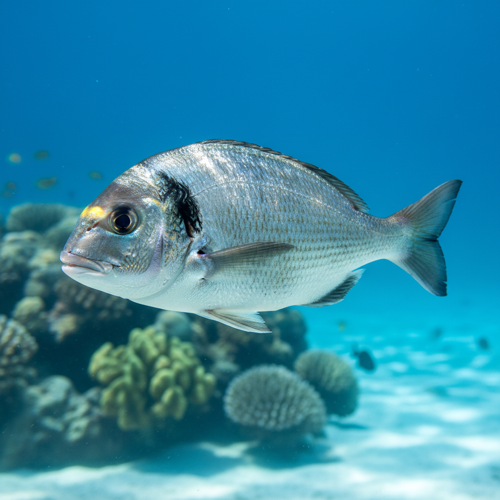
Diplodus annularis has a deep, compressed body with an elongated ovate shape. Its dorsal fin is supported by 11 spines and between 11 and 13 soft rays while there are 3 spines and 11 or 12 soft rays supporting the anal fin. There are 8 incisor-like teeth in the front of each jaw with 1 to 3 rows of molar-like teeth just behind the incisors. The overall colour is silvery grey with a yellowish tint with an almost complete dark ring around the caudal peduncle just behind the dorsal and anal fins. The pelvic fins are yellowish and the other fins are pale. The juvenile shave dark bars and the ring on the caudal peduncle is complete. The annular seabream has a maximum published total length of 28 cm (11 in), although 13 cm (5.1 in) is more typical, and a maximum published weight of 330 g (12 oz).
Habitat

Diplodus annularis is widespread in the Mediterranean Sea, in the Black and Azov Seas and in the Eastern Atlantic Ocean from the Bay of Biscay south to the Straits of Gibraltar, including Madeira and the Canary Islands. It occurs at depths between 0 and 90 m (0 and 295 ft) over rocky, sandy bottoms and seagrass beds.

Humans & conservation

Diplodus annularis is a target species for commercial fisheries and, in Sicily and the Adriatic, the fishery is semi-industrial while in others it is caught in artisanal fisheries. It is also targeted by recreational anglers. It is caught using trawl nets, beach seines, hand lines, bottom long lines and with gill and trammel nets. It is readily found in fish markets in the Mediterranean, for example it is easily available in Israel, but very infrequently sold in Morocco. The fish landed are sold fresh or as fish preserved by freezing and drying and salting. It is not highly valued as a food fish. Landed fish also go to make fishmeal and oil. There is an important fishery for this species in the Gulf of Gabes.

Part of

Where to see it

No dive sites list Annular Seabream yet. Explore the map to find sites near you.