← All marine life
Angelshark
Species IUCN · Critically Endangered (CR)

Angelshark

Squatina squatina, (Linnaeus, 1758)

marinebrackish

About Angelshark

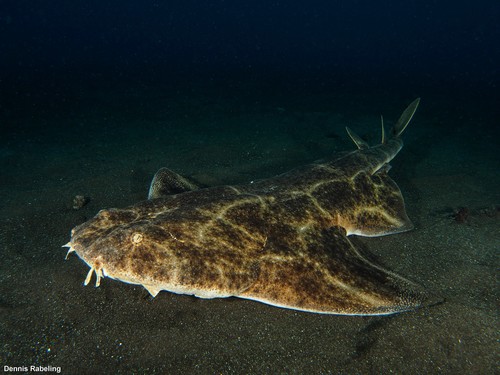
Squatina squatina, known as the common angelshark, is a species of shark in the family Squatinidae (known generally also as angel sharks), that were once widespread in the coastal waters of the northeastern Atlantic Ocean. Well-adapted for camouflaging itself on the sea floor, the angelshark has a flattened form with enlarged pectoral and pelvic fins, giving it a superficial resemblance to a ray. This species can be identified by its broad and stout body, conical barbels, thornless back (in larger individuals), and grayish or brownish dorsal coloration with a pattern of numerous small light and dark markings (that is more vivid in juveniles). It measures up to 2.4 m (7.9 ft) long.

Like other members of its family, the angelshark is a nocturnal ambush predator that buries itself in sediment and waits for passing prey, mostly benthic bony fishes, but also skates and invertebrates. An aplacental viviparous species, females bear litters of seven to 25 pups every other year. The angelshark normally poses little danger to humans, though if provoked, it is quick to bite. Since the mid-20th century, intense commercial fishing across the angelshark's range has decimated its population via bycatch – it is now locally extinct or nearly so across most of its northern range, and the prospects of the remaining fragmented subpopulations are made more precarious by its slow rate of reproduction. As a result, the International Union for Conservation of Nature has assessed this species as critically endangered.

Appearance

One of the largest members of its family, female angelsharks can attain a length of 2.4 m (7.9 ft) and males 1.8 m (5.9 ft); the maximum reported weight is 80 kg (180 lb). This species shares in common with other angelsharks a flattened body and large, wing-like pectoral fins whose anterior lobes are not fused to the head. The head and body are very broad and stocky, with small eyes positioned dorsally and followed by a pair of larger spiracles. A pair of unadorned barbels occurs in front of the nares, as well as a smooth or weakly fringed flap. Folds of skin with a single triangular lobe are present on the sides of the head. The teeth are small, sharp, and of similar shape in both jaws.

Habitat

The angelshark occurs in the temperate waters of the northeastern Atlantic, from southern Norway and Sweden to the Western Sahara and the Canary Islands, including around Ireland and Britain and in the Mediterranean. According to the IUCN, it is possible that it has been extirpated from the North Sea. It remains extant around the Canary Islands, Algeria, Tunisia, Libya, Palestine, Turkey, northern Cyprus, eastern Greece (the Aegean Sea), the Adriatic Sea of eastern Italy, Sicily, Malta, Corsica, Ireland and western Britain/Wales

Behaviour

During daytime, the angelshark usually lies motionless on the sea floor, buried under a layer of sediment with only its eyes showing. At night, it becomes more active, and may sometimes be seen swimming above the bottom. Aggregations numbering up to a hundred have been observed off Gran Canaria in the summer.

Humans & conservation

The angelshark is generally not aggressive towards humans, though it can deliver a severe bite if disturbed. When approached underwater, the angelshark usually remains still or swims away, though one circling a diver with its mouth open is recorded. Fishery workers, in particular, should treat it with caution; in the 1776 edition of British Zoology, Thomas Pennant wrote that it is "extremely fierce and dangerous to be approached. We know of an instance of a fisherman, whose leg was terribly torn by a large one of this species, which lay within his nets in shallow water, and which he went to lay hold of incautiously."

Part of

Where to see it

No dive sites list Angelshark yet. Explore the map to find sites near you.