
← All marine life
Angelshark
Group

Angelshark

Squatina, Duméril, 1805

marinebrackish

About Angelshark

Angel sharks are sharks belonging to the genus Squatina. They are the only living members of the family Squatinidae and order Squatiniformes. They commonly inhabit sandy seabeds close to 150 m (490 ft) in depth.

Squatina and other Squatiniformes differ from other sharks in having flattened bodies and broad pectoral fins that give them a strong resemblance to rays. They occur worldwide in temperate and tropical seas. Most species inhabit shallow temperate or tropical seas, but a few species inhabit deeper water, down to 1,300 m (4,300 ft). Angel sharks are sometimes called monkfish, although this name is also applied to members of the genus Lophius.

While some species occur over a wide geographic range, the majority are restricted to a smaller area. Restriction in geographic range might be as a result of the behaviour of Squatina species, which are ambush predators with a corresponding stationary bottom-dwelling habit. Thus, trans-ocean migration is extremely unlikely, even though large-scale coastal migratory patterns have been reported in species such as Squatina squatina.

Many species are now classified as critically endangered by the International Union for Conservation of Nature. Once common over large areas of the Northeast Atlantic from Norway, Sweden, Morocco and the Canary Islands, to the Mediterranean and Black Seas, fishing pressure has resulted in significant population decline.

Appearance

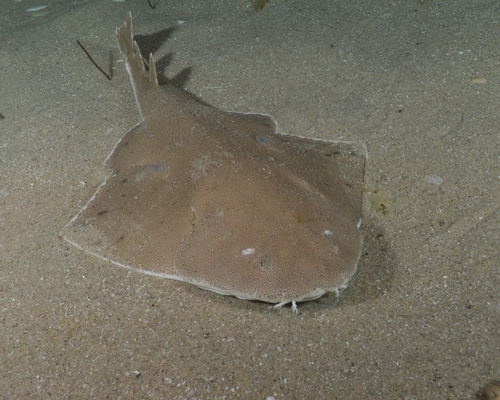
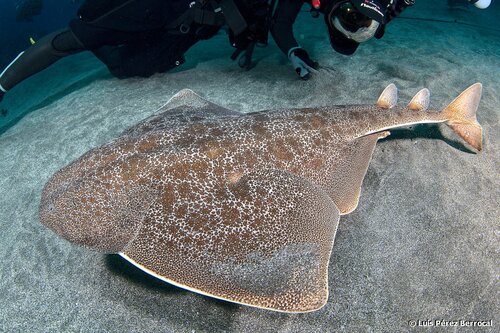
Angel sharks grow up to 7 feet (2.1 m) and can weigh around 77 pounds (35 kg), While the anterior part of the angel shark's body is broad and flattened, the posterior part retains a muscular appearance more typical of other sharks. The eyes and spiracles are dorsal and the five gill slits are on its back. Both the pectoral and pelvic fins are large and held horizontally. There are two dorsal fins, no anal fin and unusually for sharks, the lower lobe of the caudal fin is longer than the upper lobe. Most types grow to a length of 1.5 m (5 ft), with the Japanese angel shark, known to reach 2 m. Some angel sharks have deformities that have been described in elasmobranchs. These can include skeletal deformities, as lateral spinal curvature (scoliosis), humpback curvature (khyphosis), axial spinal curvature (lordosis), missing fins, additional fins, deformed snout, and more.
Habitat

Angel sharks inhabit temperate and tropical marine environments. They are generally found in shallow waters at depths from 3–100 metres (9.8–328.1 ft) off coasts. They are known to bury themselves in sandy or muddy environments during the day, where they remain camouflaged for weeks until a desirable prey crosses paths with them. At night, they take a more active approach and cruise on the bottom of the floor. Squatina preys on fish, crustaceans, and cephalopods.

Behaviour

Although this shark is a bottom-dweller and appears harmless, it can inflict painful lacerations if provoked, due to its powerful jaws and sharp teeth. It may bite if a diver approaches the head or grabs the tail.

Angelsharks have a unique way of breathing compared to most other benthic fish. They do not pump out water from the oropharyngeal cavity like other fish. Instead they use gill flaps located under their body to pump out water during respiration. Doing so also allows them to be more discreet and prevent detection.

Humans & conservation

Once considered abundant in the Atlantic Ocean, the angel shark (Squatina squatina) was classified as "Critically Endangered" in 2010, and recent studies from the IUCN in 2019 reaffirm their CR status. Angel sharks are highly sensitive to bottom trawling and are often caught in gillnets, due to their shallow habitat range.

Angel sharks found in the Mediterranean Sea, S. aculeata, S. oculata, and S. squatina, are at a high risk of extinction, with geographic studies projecting severe population declines for the three species. The Angel Shark Conservation Network, a network established by the IUCN and Shark Trust, is working with authorities from Greece and Turkey to establish conservation strategies to protect angel shark populations in the region.

Species in this group

Where to see it

No dive sites list Angelshark yet. Explore the map to find sites near you.