
← All marine life
Amur Carp
Species IUCN · Least Concern (LC)

Amur Carp

Cyprinus rubrofuscus, Lacepède, 1803

brackishfreshwater

About Amur Carp

Cyprinus rubrofuscus, or the Amur carp, is a species of freshwater fish belonging to the Cyprinidae family. It is the ancestral form of some domesticated koi fish, which are well known for their striking colors as an ornamental species. Often mistaken for the common carp (Cyprinus carpio), the species originated in eastern Asia but has since been widely distributed and cultured across the world. Common names include Amur carp and South China carp.

Appearance

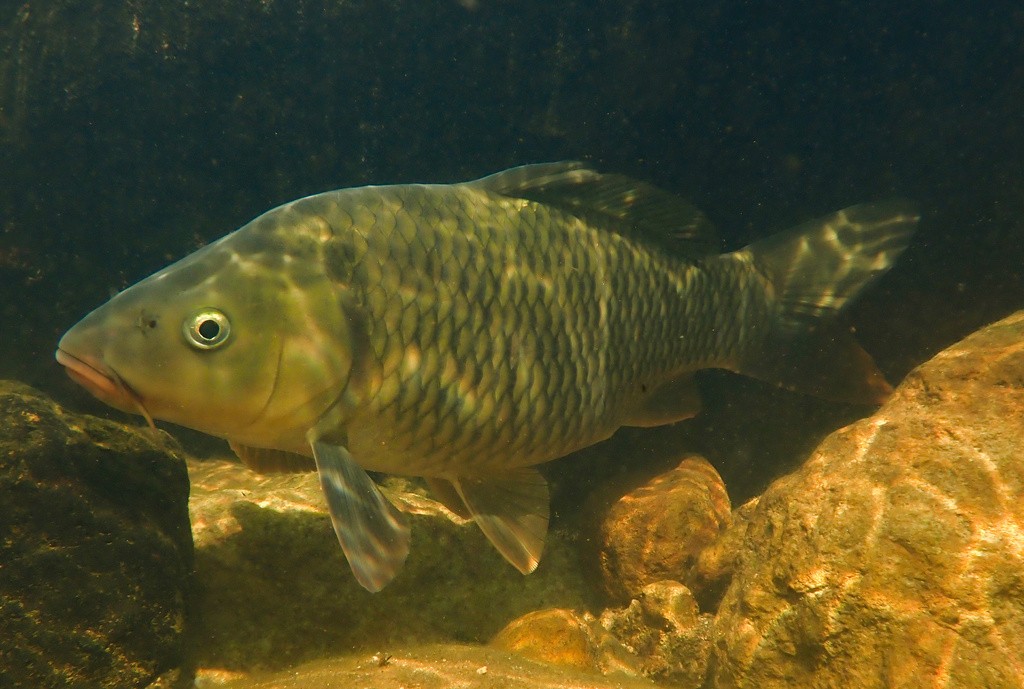
C. rubrofuscus is characterized by a fusiform body shape, varying in roundness. The typical size ranges from 30–60 centimetres (12–24 in), weighing in at around 50–350 grams (0.11–0.77 lb) depending on the life stage. It has large, bright elasmoid scales, which fully overlap and sit in the dermis pocket. The thin and elongated dorsal fin runs down the posterior half of the body, and it has large pectoral fins. The Amur carp typically has 29 to 33 (+2–3) lateral line scales, and 18–22.5 dorsal rays which are branched. The most posterior anal ray is bony and serrated, and it has a lightly forked caudal fin. The sub-terminal mouth is turned downwards and is protrusible. Like many other bottom-feeding cyprinids, C. rubrofuscus has four barbels which function to detect food and receive other mechanical stimuli.

Habitat

Originating from Eastern Asia, the native range of the Amur carp is in Mongolia, Russia, China, Laos, and Vietnam. It is found in mostly freshwater environments such as the Amur and Red River drainage basins and ponds, but is tolerant to slightly brackish water. C. rubrofuscus has been widely introduced throughout ponds in southeastern Asia, and is distributed for aquaculture purposes. In regards to distribution data, most reports group both ornamental Koi and the wild Amur carp. At present, it can not be determined which of the two the occurrence points represent.

Behaviour

The carp life cycle can be categorized into five groups: adults, eggs, larvae, young, and subadults. Fully grown carp possess the most tolerance for variable conditions, and prefer to live in schools. Adults will seek out sheltered, shallow water with low velocity to spawn. Carp eggs typically hatch within two to eight days, depending on the water temperature. Once hatched, larvae develop quickly and fry may travel upstream or downstream. Fingerlings will feed on the water column, but transition to bottom-feeding as they mature.

Use of the scales to age carp is the most common, but counting the growth rings of otoliths remains the most accurate method.

Humans & conservation

The International Union for Conservation of Nature (IUCN) assessed Amur carp to be of Least Concern due to its large distribution. It currently has no known widespread threats to the species as of 2022. However, official distribution data has not been updated since 2010, and the population trend remains listed as unknown.

Where to see it

No dive sites list Amur Carp yet. Explore the map to find sites near you.